





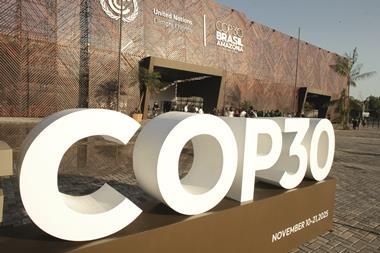
COP30 had many nicknames. Some called it the ‘COP of Truth’, because world leaders were forced to face up to the lack of progress that has been made so far against national decarbonisation pledges.
For Brazil, which hosted the event, this made it the ‘Implementation COP’ – finally moving from promises to actions.
But others referred to it as the ‘Adaptation COP’, because the lack of implementation means governments will have to refocus on dealing with the increasingly inevitable impacts of climate change.
Its location in the Amazon meant it was also described as the ‘Forests COP’.
Outcome
Whatever its identity, it was not a big success.
Plagued by logistical problems, Amazonian heat and even a big electrical fire, the negotiations were extended by a day in a desperate attempt to secure agreements between the 190-plus governments in attendance.
In the end, plans for a roadmap for transitioning away from fossil fuels were removed from the final text, and there was no mention of reforming fossil-fuel subsidies or putting a halt to deforestation.
Instead, on Friday morning, 24 countries – including the Netherlands, Denmark, Finland, Ireland, Belgium, Austria and Australia – signed a pledge to “work collectively towards a just, orderly and equitable transition away from fossil fuels”, with more nations expressing interest.
The Brazilian presidency also announced its own initiative process to develop a roadmap to halt and reverse deforestation. Brazil keeps the presidency of the United Nations climate change summit until next November.
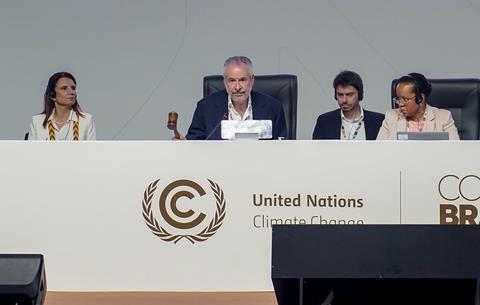
A new ‘Belém Mission to 1.5’ was also set up, which tasks the COP 30 and 31 presidencies to deliver a report on enabling ambitious national pledges and plans to be implemented.
On the finance side, however, there were a number of developments.
Living up to its ‘Adaptation COP’ mantle, a new goal was agreed that will require countries to triple their adaptation finance by 2035, putting the figure at an estimated $120bn (€104bn) annually.
Asset owners
COP30 was the first climate summit with an official event for asset owners.
Hosted by Generation Investment Management, the COP30 presidency convened around 30 undisclosed pension funds, insurers, endowments and sovereign wealth funds to discuss climate solutions – especially for hard-to-abate sectors and emerging markets and developing economies.
“As outcomes of the meeting, asset owners proposed establishing a standing COP Asset Owner Summit and sent the signal that they are committed to scaling partnership with the public sector towards the $1trn required to meet the New Collective Quantifiable Goal,” the Brazilian presidency wrote in a statement.
Unlocking private capital
Asset owners also met with finance ministers, multilateral development banks (MDBs), financial institutions and companies during the summit, to discuss ways to unlock the $1.3trn of annual finance outlined in the Baku to Belém Roadmap.
The result was a report that the COP30 presidency described as “a catalytic blueprint to rapidly scale climate finance with greater speed, scale, and impact”.
The Circle of Finance Ministers, which comprises ministers from 35 countries, made recommendations on concessional and blended finance, regulation, and development bank reforms.
They also explored the need for countries to have enough national capacity to attract sustainable investment, which was reinforced by the launch of a Country Platform Hub.
With technical support from the Green Climate Fund, India, Nigeria and South Africa were among 13 countries to release plans to develop national platforms to help stimulate investment.
The COP Presidency said the recommendations made by the Circle of Finance Ministers would help turn the Baku to Belém Roadmap into “a unifying vehicle to mobilise the blended, public, and private capital required to meet global climate goals”.
Moves to boost green bond issuance
Finance ministers also teamed up with the sustainable business arm of COP and the Climate Bonds Initiative to launch the Principles for Taxonomy Interoperability.
The principles are intended to help policymakers create and manage usable taxonomies that can be adopted by financial and non-financial companies – especially those wishing to buy and sell green bonds.
Meanwhile, a coalition including the International Development Finance Club, the Multilateral Investment Guarantee Agency, Finance in Common, and the NDC Partnership reportedly formed a groundbreaking new guarantee platform at COP30.
The Public Development Bank Guarantee Hub is set to provide $10bn to help more MDBs tap the green bond market by offering full guarantees for debut issuers, as well as technical assistance.
The hope is that it will enable the number of development-bank issuers to double by the end of the decade, and channel more private capital into sustainable projects on the ground.
Read the digital edition of IPE’s latest magazine






.jpg)