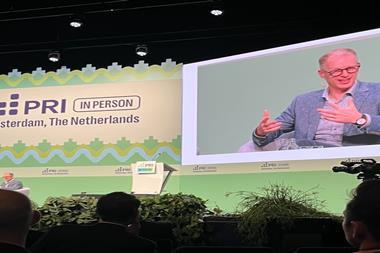






“The next chapter of responsible investment is not simply identifying risks; it is helping to build the conditions that allow capital to respond to them,” interim PRI chief executive officer Cambria Allen-Ratzlaff told delegates at PRI in Person.
The annual conference, organised by the Principles for Responsible Investment (PRI), brought together more than 1,500 attendees in Amsterdam last week. Allen-Ratzlaff’s opening remarks reflected the event’s overriding mood: less talk, more action.
UN secretary-general António Guterres echoed this in his video address: “The choices investors make today will determine the economies and societies of tomorrow.”
Marking the PRI’s 20th anniversary, Allen-Ratzlaff said: “Twenty years ago, six principles were a promise; what now matters is the practice.”
From targets to delivery
The conference mood was one of pragmatic optimism, with investors telling IPE that the responsible investment community was emerging from a difficult period marked by geopolitical and regulatory headwinds, including the ESG backlash. Some investors, however, felt the backlash had been overstated.
One investor described the road ahead as “a marathon and not a sprint”.
Investors asked tougher questions about credible transition pathways and real-world decarbonisation. Net zero targets and methodologies divided opinion, with some seeing targets as a useful organising principle and others warning that incentives could encourage progress on paper rather than in the real economy.
Caroline Le Meaux, global head of ESG research, engagement and voting at Amundi, told IPE that changing the route to net zero should not automatically be interpreted as abandoning ambition.
“Targets are nice, but I think we are past targets because now we are in delivery mode,” she said.
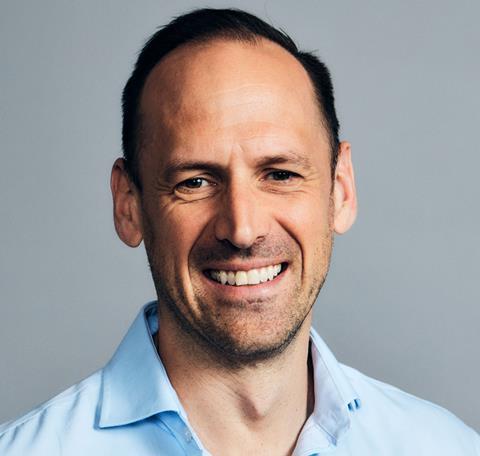
During a plenary on how investment leaders are adapting to the market, Dan Mikulskis, chief investment officer at People’s Partnership, provider of The People’s Pension, questioned the limits of financial-market approaches to climate outcomes.
“You could sort of categorise some of the activity five years ago as a financial market solution to an atmospheric physics problem,” he said, adding: “So I think there is a more honest assessment now of the limitations of what can be achieved, but then leaning into what can be.”
Mikulskis argued that transition risks had not been priced as expected, with markets rewarding fossil fuels relative to renewable energy.
“I think maybe five years ago there was this sort of sense of inevitability that risk would get priced in, that the business case for transition would remain very very strong, and those were very reasonable things to believe five years ago,” said Mikulskis.
“The reality is, it just hasn’t happened. If anything, it’s got a bit further away,” he noted.
Fellow panellist Anton Eser, CIO at Robeco, stressed the importance of asset owners setting objectives at the outset of investment mandates.
“A lot of this has become much more asset owner driven, with the asset manager providing the data, providing the IP, providing all the quant analysis as an input into the mandate design, and that has to happen very clearly upfront. There needs to be alignment there at the beginning of the mandate,” said Eser.
Systemic risks on the agenda
On the sidelines of the conference, investors told IPE they were keen to discuss systemic risks associated with climate change, nature loss and artificial intelligence (AI), including the technology’s potential impact on labour markets and longer-term risks.
The PRI’s Global Asset Owner Forum, a day of workshops and peer discussions before the main conference, brought together 200 asset owners and focused largely on system-level investing, IPE understands.
Discussions explored the interconnected risks posed by climate disruption, water and food insecurity, geopolitical conflict and energy shocks.
AI debate divides delegates
A plenary debating the motion “AI demands a climate-style investor response” explored how investors should approach AI governance and prevent harm as the technology becomes more widely adopted across the industry.
Dan Firger, founder and managing partner of Great Circle Capital Advisors, argued that the Task Force on Climate-related Financial Disclosures (TCFD) already offered a tested framework for addressing AI risks, covering governance, strategy, risk management, and metrics and targets.
Opposing this view, Christy Hoffman, general secretary of UNI Global Union, said: “It’s not enough to have transparency without rules that require that the company address the problem, or in the case of investors, follow up with consequences.”
Investor concerns included board oversight, governance throughout AI’s lifecycle, human-rights due diligence, escalation through proxy voting and greater investor participation in policymaking.
The motion was debated before a packed room of more than 1,000 investors. An initial poll showed 64% in favour, but the result shifted to 93% against after the session, prompting some tentative chuckling and applause from delegates.
SFDR reform
Meanwhile, the European Sustainable Investment Forum (Eurosif) warned that allowing alternative investment funds marketed exclusively to professional investors to opt out of the EU’s Sustainable Finance Disclosure Regulation (SFDR) categorisation framework could leave investors facing inconsistent sustainability disclosures.

Simplification should make the framework more effective and easier to implement, not weaken its objectives or create new uncertainty
Speaking during a debate on SFDR, Eurosif executive director Aleksandra Palinska questioned whether the EU’s drive to simplify sustainability reporting had gone too far.
“Simplification should make the framework more effective and easier to implement, not weaken its objectives or create new uncertainty,” she said.
Nature-related disclosures
At the conclusion of PRI in Person, the Taskforce on Nature-related Financial Disclosures (TNFD) released updated recommendations and assessment guidance, including guidance on assessing nature-related risks across financial institutions’ portfolios.
It also announced that 836 organisations had committed to TNFD-aligned reporting, with financial-institution adopters representing more than $26trn (€23trn) in assets under management.
PRI chair Conor Kehoe confirmed that PRI in Person 2027 would take place in Hong Kong next October.




Topics
- Amundi
- Artificial Intelligence
- Asset Allocation
- Asset Managers
- Climate change
- climate transition
- Corporate governance
- decarbonisation
- disclosure
- Eurosif
- fossil fuels
- geopolitics
- Impact
- investment risk
- Markets
- net zero
- People’s Partnership
- Principles for Responsible Investment (PRI)
- Reform & Regulation
- renewable energy
- responsible investment
- Robeco
- Sustainability
- Sustainable Finance Disclosures Regulation (SFDR)
- Task Force on Climate-related Financial Disclosures (TCFD)
- Taskforce on Nature-related Financial Disclosures (TNFD)
- The People's Pension