





In the last of a four-part series on stewardship and shareholder engagement, Sophie Robinson-Tillett talks to asset owners about their mixed views on stewardship
The investment industry is experiencing a “stewardship recession”.
That’s what Catherine Howarth, the chief executive officer of campaign group ShareAction, calls the current climbdown by asset managers around voting and engagement in the face of opposition from US politicians.
During a panel discussion at Oxford University last week, Howarth said that, while it was frustrating to see enthusiasm for this approach to sustainability wane, there are upsides.
“When the tide goes out, you get to see who’s for real,” she said, adding that this reality “poses challenges for asset owners with policies that say stewardship is an important part of risk management for them”.
“Where should they allocate their mandates now?”
LGPS Central is one such case: the UK pension pool recently developed a new stewardship strategy with its partner funds, as part of its “continued commitment to responsible investment and stewardship”.
Patrick O’Hara, the pool’s head of stewardship, says: “It’s disappointing to see managers who portray themselves as having high conviction around ESG and responsible investment pulling back.”
The trend, which has seen more than 100 investors exit groups like Climate Action 100+ and the Net Zero Asset Managers initiative, has prompted O’Hara and his team to be “more rigorous” when monitoring managers.
“When they leave collaborative engagement groups, they always claim they’re still just as committed to sustainability,” he says.
“We’ve got to really hold their feet to the fire to make sure that’s true, and that they don’t change the way they vote, and so on.”
Dropping managers
It’s this logic that contributed to Denmark’s AkademikerPension ending its relationship with State Street Investment Management earlier this year.
The decision was part of a broader initiative to pare back its external managers, but AkademikerPension had also just downgraded State Street’s ESG score as part of an internal review.
“So even without the new strategy, we would still have had to terminate State Street due to that,” explains Anders Schelde, the fund’s chief investment officer.
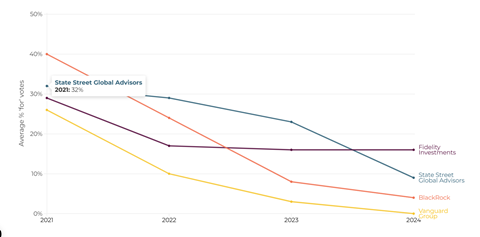
He says the downgrade to a ‘C’ – the lowest option – was due to “changes we saw at State Street”, including its withdrawal for CA100+.
“They talked about withdrawing due to the legal challenges in the US, and spoke about continuing to engage as they have always done,” says Schelde. “But we could see the way they voted had changed.”
Data published by ShareAction in February shows a steep drop in State Street’s support for environmental and social resolutions at annual meetings between 2023 and 2024 (see table).
LGPS Central retains its own voting rights, but O’Hara and his colleagues are monitoring how their managers vote other clients’ shares.
“You’ve got to have some convictions as a house,” he says.
It’s a viewpoint that’s falling out of favour, with many arguing that asset managers are simply service providers, and should therefore follow the wishes of each client.
Last year, Günther Thallinger, a board member at Allianz and then-chair of Net Zero Asset Owner Alliance, told IPE it was “really understandable” that asset managers didn’t want to pursue sustainability at entity level.
O’Hara disagrees. “We want managers that have a strong organisational culture, with leadership that holds a clear set of beliefs about corporate conduct,” he says.
“That’s really what’s slipped lately: we’re moving too far in the direction of short-term pragmatism over long-term returns. We need managers to have our long-term interests at heart.”
Silence from asset owners
Natasha Landell-Mills hopes more asset owners will start speaking up about their need for stewardship.
“There’s an element of silence at the moment, at a time when asset owners need to respond to what’s going on,” says the head of stewardship at £18.5bn investment house Sarasin & Partners.
“Asset managers will not take stewardship seriously unless their clients are clear that it’s important to the mandate.”
Sarasin has been one of the most vocal managers, even during the recent period of quiet in the market.
In March, it announced it was divesting Norwegian energy giant Equinor after failing to convince it to improve its climate transition strategy. It wrote to the company explaining its decision, and published that letter on its website.
“Continuing to take this seriously while some other managers row back on their commitments needs to be a commercial advantage,” points out Landell-Mills.
“And the clearer the influence it has on who is getting and losing mandates, the easier that becomes.“
Asset owners have to demonstrate that assets will flow towards responsible stewardship if they want responsible stewardship to happen.”
Read more
Shareholder engagement: what works and what doesn’t?
Read the digital edition of IPE’s latest magazine




Related Companies
- Previous
- Next








.jpg)