In the second article on a new survey, Vincent Mortier, Monica Defend and Amin Rajan argue that greater granularity in ESG investing is set to boost impact investing
Key points
- Trade-offs inherent in ESG pillars are promoting thematic investing
- The selected themes are seen as crucial to long-term value creation
- Stewardship and proxy voting will play a central role in the transition

In the early phase of their environmental, social and governance (ESG) journey, pension plans invested in vanilla single-score composite funds, only to discover, over time, that they were based on a huge oversimplification of a variety of factors that go into ESG.
As pension plans progressed up the learning curve, the result was the rise of a microscopic approach. It focused on specific themes within each pillar, as they became aware of the trade-offs between and within individual ESG pillars, according to our latest survey, ‘The next stage of ESG evolution in the pension landscape’.
The early phase of ESG investing mostly bundled the three pillars together, using composite data from rating providers. However, recent growth has seen greater granularity between and within the pillars. Currently, environment attracts the highest ranking (cited by 54% of our survey respondents) followed by social (32%) and governance (14%). But the story is far more nuanced.
The ranking varies across three key regions. In Asia-Pacific, the focus is on governance, in Europe it is on environment and in North America it is on social. Differences in regulation and business cultures are a major factor. Furthermore, there are trade-offs between the individual pillars of ESG.
The trade-offs
The key trade-off centres on stranded carbon assets, caused by premature write-downs ahead of their economic life as part of climate action. Academic studies show that up to 80% of the known fossil fuel reserves of publicly listed companies today face this prospect, inflicting severe hardship on local communities. A just transition that greens the global economy in a fair way remains a formidable challenge.
The war in Ukraine has raised two challenges. First, whether it is ethical to invest in controversial weapons manufacturers that are helping Ukraine fight Russia; and second, whether traditional oil and gas companies should still appear on the exclusion list as they seek to plug the energy shortfall caused by the war.
The social pillar, too, has challenges. Social media giants, with their emphasis on talent, score highly on the social factor, but there are serious concerns about whether uncensored material on their platforms harms political stability in democracies and children’s well-being. These Leviathans have an immense unregulated influence on our opinions.
This interest in specific themes is also inspired by two types of inter-related risks that are embedded within individual ESG pillars.
The first is event risk. This is driven by short-term events, such as governance lapses or tax fraud, that can hit stock prices. A recent example is the sudden implosion of Wirecard in Germany once fraud was exposed.
The second type is erosion risks, which can lower stock prices over time as they unfold gradually. Climate change is a good example, even though it is also exposed to event risk via flooding and wildfires. Social factors, too, are exposed to both types of risks. Poor labour relations can hit profitability in the short term via industrial disputes and in the long-term via low productivity.
Main themes
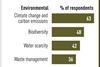
The emerging granular approach has favoured various themes (figure 1). In the environmental area, at least one in three survey participants favours four themes: climate change and carbon emissions (63%), biodiversity (48%), water scarcity (42%) and waste management (36%). These are seen as some of the building blocks of a circular economy that aims to reduce greenhouse gas (GHG) emissions and prevent biodiversity loss without compromising economic growth. Indeed, climate change and biodiversity are seen as two sides of the same coin. Global warming is not just a result of GHG emissions but also unsustainable land use and deforestation, which reduce the capacity of natural carbon sinks.
Case study: a Swedish pension plan
“Our ESG investments have evolved from negative screening to integration into our investment process and then to thematic investing with the clear intention of producing quantifiable social and environmental outcomes, on top of decent financial results. Our chosen themes focus on long-term mega secular trends that outlive market cycles.
“As the infrastructure of data and skills improve over time, thematic funds are likely to morph into impact investing, which is our ultimate goal. Stewardship and proxy voting will play a big role in that process.
“As a universal owner, we have big equity stakes in companies with the highest potential to make the transition. We are actively engaging with them to create actionable and profitable pathways towards the energy transition and the SDGs. This approach is essential in the absence of a universal definition and reporting frameworks on impact investing.
“Currently, we use standards from independent organisations like the Task Force for Climate-related Financial Disclosure and the Impact Management Project. But that adds to the complexity in our investment process. In climate-based funds, some measure carbon footprint, some biodiversity and some water management. On the social side, too, some measure workforce diversity and some human rights. This is inevitable, as singular composite metrics on corporate ESG scores have very limited worth in assessing outcomes.”
A Swedish pension plan
In the social pillar, at least one in three survey participants favours four themes: diversity and inclusion (64%), employee engagement and labour standards (57%), human rights (42%) and data protection and privacy (32%). Each of these raises challenges. First, standards can vary between cultures and regions – norms that are acceptable in one market may not be so in others.
Second, these areas are seen as generating positive externalities that are observable, not measurable. As such, they are seen as ‘public goods’ that come under the remit of governments, not capital markets. The latter need incentives and sanctions to price them.
In the governance pillar, at least two in five participants favour four themes: executive compensation linked to ESG outcomes (61%), diverse board composition (57%), an independent audit committee structure (46%) and zero tolerance towards bribery and corruption (40%). In the West, the current best-practice governance model sees these features as most conducive to ESG investing. They indicate how the company’s strategic vision and business values are aligned to ESG goals.
So far, thematic investing has focused on ‘pure play’ companies in private and public markets where strategic purpose and business models are focused on chosen themes like renewable energy and green infrastructure. Capital markets have less problem pricing them and delivering ‘green’ alpha.
In contrast, the incursion of thematic investing into hard-to-abate sectors, like aluminium, cement and steel, remains subdued. But incentives and sanctions in the emission trading systems are beginning to have an effect, especially in the EU.
Previously it was unclear who actually pays for sustainability goals.
Convincing companies in these commoditised sectors to go green remains a challenge. When competing on a global basis, raising prices is not an easy option, nor is cutting dividends. Good yield is what attracts investors to these smokestack sectors in the first place.
Hence, current practice is to favour themes with greater conviction and evidence, and underweight those with a less supportive outlook.
The themes that command greater conviction transcend typical categorisation by conventional country, sector or style factors. With their novel business models, such themes often provide structural tailwinds for sustainable growth and profitability. They typically focus on mega trends that disrupt industries and give rise to predictable sources of value creation that ride out traditional market cycles. Indeed, this selectivity is symptomatic of a gradual convergence between thematic investing and impact investing.
Stepping stone to impact investing
Impact investing stands out from other ESG approaches because it targets a measurable double bottom line: doing well financially and doing good socially. It also differs from philanthropy by ensuring that financial returns and impacts are interdependent. While the required measurement frameworks are slow to evolve, these demanding features have ensured that the adoption of impact investing is relatively low compared with other ESG approaches. So far, impact investing has been the preserve of mainly large institutional investors with the necessary skill sets and governance structures.

They target the delivery of at least risk-adjusted market-level returns (figure 2). Only 14% of survey respondents regard this hurdle rate as non-essential, and even then, only as long as the investments offer an acceptable level of positive absolute returns. So far, allocations to impact investing among a sample of our survey participants have averaged around 5% and are growing at a compound annual growth rate (CAGR) of 5%. This reflects the modest progress towards a commonly agreed measurement framework.
As for the choice of assets so far, alternative investments in private markets have proved more amenable to impact investing, according to 52% of our survey respondents. Private equity, private debt and infrastructure top the list, given the customised nature of their mandates and reporting requirements. They also have corporate governance advantages over other asset classes as well as long duration mandates, which allow for ESG risks to materialise.
Private equity firms are also well placed to participate in public-private partnerships in blended finance vehicles (38%). These typically cover new industries, new technologies and new markets focused on innovative impact solutions.
Such vehicles offer two kinds of premia: investment premium, by backing high-conviction long-horizon themes; and leverage premium, by pooling their resources to create scalable investment strategies. These are essential, since advances in green hydrogen and carbon-capture systems require high-risk capital up front. Blended finance initiatives are also increasingly attracting asset managers specialising in public market assets.
Another favoured asset class is bonds – green, social, sustainability and sustainability-linked (47%). Although they overly rely on a quantitative approach based on interest rates, inflation, credit quality and liquidity, they are seen as the most transparent vehicle for ensuring that they have a real-world impact on top of netting financial results. This is particularly true of green and social bonds, where their proceeds are exclusively used to finance projects with tangible impacts.
Finally, equities in public markets are at the bottom of the list (32%) for two reasons. First, while the number of pure-play impact companies in this area is growing, it remains small, which gives rise to concentration risks.
Second, public equities are principally traded in secondary markets and their role has changed over time – from providing investment capital for growing companies, to a vehicle for cash distribution and balance sheet management that involves the second-order trading of existing paper assets. However, the role of equity markets is expected to grow, as the quality of ESG data improves and stewardship activities move up a gear or two.
Centrality of stewardship role
Stewardship is likely to play a crucial role in the transition from thematic investing to impact investing. Under new regulation, like the EU’s Corporate Sustainability Reporting Directive, stewardship is about being an active owner, not a trader. It urges pension plans to manage their assets prudently by engaging directly with investee companies and exercising voting rights, filing or co-filing shareholder resolutions, having a say on political lobbying activities and fostering year-round dialogue on issues around value creation and climate impact.

This form of shareholder activism is seen as being more effective in affecting change than divestment. Rather than divesting companies, it seems more prudent to engage with them to influence their ESG strategies and monitor the outcomes. This is in the belief that engagement and advocacy is the only effective approach for true change in the ESG space; those who are part of the problem can also be part of the solution.
Additionally, in economic terms, stewardship is also a public good. This means that the benefits of engagement are enjoyed by all investors, whether or not they behave as responsible long-term owners. The familiar ‘free rider’ problem is ever present. In order to counter that, many of our survey respondents expect their asset managers to belong to global networks of like-minded peers that collaborate when engaging with their target list of companies. The key networks include the UN Principles of Responsible Investment, Climate Action 100+ and the Net Zero Asset Managers Initiative.
Stewardship and proxy voting
As central banks have withdrawn liquidity to tackle soaring inflation, pension investors expect asset values to revert to their fundamentals. Thus they are shifting attention to thematic investing as a way of capitalising on the predictable sources of value creation in the global economy.
On a parallel track, stewardship and proxy voting have become the most widely used approach to ESG investing. They are also seen as a catalyst promoting the transition from thematic investing to impact investing.
Vincent Mortier is the group CIO at Amundi Asset Management, Monica Defend is head of Amundi Investment Institute and Amin Rajan is CEO of CREATE-Research and a member of The 300 Club