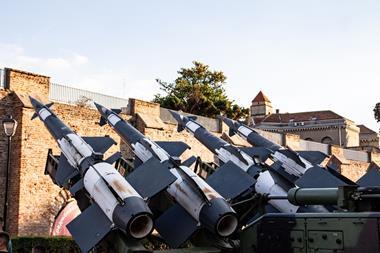

Many European pension funds are reviewing their allocations to the defence sector as they seek to recalibrate ESG criteria to embrace national and European strategic resilience.
Defence exposure and ESG policies should be uncontroversial. Investors have the right to take positions. The underlying issues are nuanced and complex (transparency and corruption in the defence sector, for instance), and there may be specific issues for each investor to take into account.
A large sovereign fund is likely to focus on compliance with international norms on defence and weapons; a workplace scheme might take member views into account; a foundation or endowment could take an explicitly ethical stance. It’s important, nevertheless, that investors are free to exercise fiduciary duty so that these decisions remain part of investment and free from politics to the greatest extent possible.
Norway’s decision on the part of its Government Pension Fund Global (GPFG) last year to divest from Caterpillar and five Israeli banks provoked controversy in the US – where the Trump administration said it was “very troubled” by the move, and there were suggestions of sanctions by a senator.
Norway immediately announced a review of the ethical guidelines of the GPFG and one can assume some diplomacy took place behind the scenes. It must have been a shock that what seemed like a relatively uncontroversial decision, in line with domestic public opinion, took such a worrying turn.
This case is important because other large European investors may come into the firing line in future for decisions that may not be seen ex ante to be either controversial or to have an explicitly political dimension. In a world of capricious and fractious social media, it can be hard to predict whether or how legitimate decisions might suddenly be subject to the intense gaze of public scrutiny.
Some investors have decided to reverse previous exclusions. For PFA, Denmark’s largest occupational pension fund, increasing defence investment has brought its aerospace and defence allocation in line with the sector’s weighting in the global index. As defence holdings have expanded, the fund has started to think about engaging with a sector that has historically been rather averse to investor scrutiny.
Enhanced scrutiny can work in two ways – better engagement with defence firms could lead to fewer grounds for divestment by helping investee firms sidestep controversies. Constructive scrutiny of the sector can hardly be a bad thing.
Exclusions and divestments are still likely to happen – meaning investors need to spend more time on making a watertight case when this is the decision. Many think that Norway, for instance, needs to take a rigorous approach to its position as an index investor, and should apply a more robust framework around future portfolio exclusions or divestments.
But European investors should prepare for unplanned scrutiny, perhaps global, and be prepared to justify decisions publicly, robustly if needed.
They should also take into account much more dangerous scenarios in which ownership rights are questioned or where weaponised, politically targeted action may be taken against them, perhaps even hindering their access to global financial architecture. The unthinkable is rapidly become very thinkable.
Liam Kennedy, Editorial Director