Net sentiment on US equities has declined sharply over the past months, reaching negative territory for the first time in nearly two years
Political risk: US and EU divergence
Having abandoned his “peace-making” efforts, US president Donald Trump has once again turned his attention to tariffs, throwing up another wave of uncertainty for international trade. Trump’s threats towards the independence of the US Federal Reserve and his intention to devalue the US dollar could severely undermine its position as a reserve currency.
By contrast, there is much good news coming out of the EU. Rates have converged to the point where the Italy-France spread is narrowing towards zero. Bulgaria finalised an agreement to enter the euro area, and Romania is set to introduce the currency. The tide seems about to turn against the far-right government in Hungary, ahead of elections next April. Denmark has become significantly more enthusiastic about EU co-operation, particularly around defence.
The political interests of leaders in the UK and France are converging around illegal immigration. Their mutual agreement on the issue, effective from early August, could ultimately serve as a model for an EU/UK pact, satisfying UK prime minister Kier Starmer’s promise for better EU relations and French president Emmanuel Macron’s wish for closer European military co-operation. However, in Britain, Nigel Farage’s Reform, which leads the poll, is against the agreement.
Asset allocation: EU expectations hold up
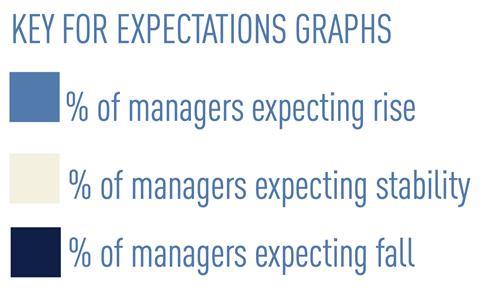
Net equity sentiment statistics have developed spectacularly. Since last February, the US number has decreased by around 20% each month and is now in negative territory for the first time since November 2023. The numbers for Japan and the UK have also been trending down, albeit more mildly. The EU statistics are holding up fairly well, so the divergence trend is continuing, making the US look risky and the EU a safe haven.
Over the past month, net bond statistics were jointly creeping lower everywhere except in Japan, where they moved sideways on a very low level. UK bond uncertainty climbed above equity uncertainty.
Country allocation: Japan’s bond analysts raise the alarm
In the US, faith in both equity and bonds is low and trending down, with an increasing vote for uncertainty. EU analysts remain relatively optimistic on equity. Their uncertainty vote for equity is quite neutral, while the neutral vote for bonds remains at a higher level. The situation in Japan remains unchanged, with a neutral vote of 55% that signals very high uncertainty among Japan’s bond analysts.
Net sentiment equities

Net sentiment bonds

Click here to download the complete PDF
Peter Kraneveld, international pensions adviser, PRIME bv
Supporting documents
Click link to download and view these filesIPE Quest Expectations Indicator - August 2025
PDF, Size 0.62 mb