

Allianz has developed an investment taxonomy for climate adaptation, saying that classification and transparency are “foundational” to efforts to mobilise more capital for an “opaque and commercially challenging asset class”.
Adaptation has been gaining attention in the investment industry recently as the effects of climate change have become more noticeable and severe, underscoring the need for more investment in an era of tight fiscal budgets. The area remains “conceptually diffuse and empirically fragmented,” however, Allianz said.
Published in a report earlier this month, the insurer’s taxonomy captures 61 adaptation measures and classifies them according to their underlying economic and financial characteristics, particularly the extent to which benefits can be monetised and captured by private actors.
According to the insurer, this approach “yields a differentiated mapping of financing modalities”.
About two-fifth of measures (38%) come out as primarily public in nature, notably large-scale infrastructure and system-level resilience while private capital accounts for 23% of the identified measures, such as cooling technologies and climate analytics.
In hazard terms, Allianz said, heat stress emerged as the dominant area for private adaptation investment.
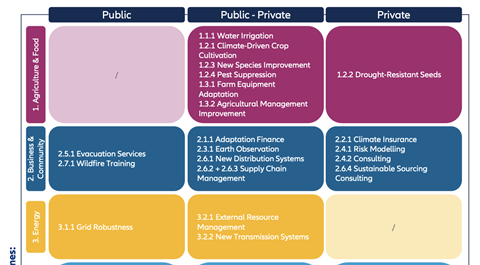
The largest category in the taxonomy is the public–private territory, which accounts for 39% of adaptation measures (24 of 61). highlighting the central role of risk-sharing mechanisms.
“Overall, the analysis shows that climate adaptation is primarily driven by public capital,” said Allianz.
“However, scaling investment will also require private finance in segments with viable market potential, while public capital remains essential to de-risk investments in areas where returns are uncertain or non-commercial.”
Not an allocation guide
The insurer cautioned against reading the taxonomy as offering “the optimal allocation of adaptation finance”, saying investment volumes varied significantly across activities and were still difficult to quantify consistently.
“Rather than providing a capital split, the taxonomy offers a structural framework to understand investability and guide the respective roles of public, private and blended finance.”