

Dutch pension funds that moved to a new defined contribution (DC) arrangement at the beginning of this year have scooped up large amounts of short-term swaps around their transition date.

Swaps with a maturity of more than 25 years were sold, separate analyses by financial regulators DNB and AFM have shown.
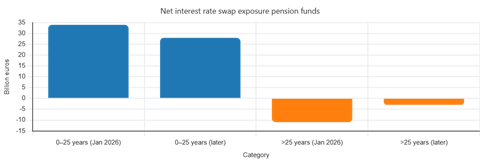
Between October 2025 and March 2026, pension funds that moved to DC on 1 January 2026 bought almost €34bn in net interest rate swaps with a maturity of less than 25 years, according to the analyses.
Funds that will switch at a later date also bought such swaps, for a total of just under €30bn.
According to DNB, trading activity was much higher than normal over the period. In the first nine months of last year, the composition of the swap portfolios of the transitioning funds had hardly changed.
“When we looked at the interest rate swap portfolios of these funds throughout 2025, we saw relatively little activity,” said a DNB spokesperson.
The funds probably bought the extra short-term swaps to provide additional funding ratio protection, and because they have different hedging needs in the new DC system.
This is because the average maturity of the swaps required for their interest rate hedging decreases. Funds that have switched to DC often increased their hedges for older members and reduced them for younger participants. To do this, they need more short-term and fewer long-term swaps.
That is why mainly swaps with a maturity of more than 25 years were sold. Between October and the end of March, a net amount of more than €12bn worth of such swaps were sold by fund transitioning to DC. Funds that will convert later also sold several billion euros worth of such swaps.
At the end of last year, pension funds held approximately €88bn in interest rate swaps with a maturity of more than 25 years, which is equivalent to approximately 25% of the European market.
No market movements
However, the massive transactions have hardly led to market movements because pension funds have often gradually adjusted their interest rate hedging, according to DNB.
“After the transition date on 1 January, there have been no major movements in interest rate swap markets,” DNB said in its report. “This indicates that the reduction of interest rate swaps has been smaller and more spread out than expected by market participants.
“For example, several funds had already adjusted their interest rate hedging before January, while other funds have gradually implemented their adjustments this year.”
However, most Dutch pension assets will not be converted to DC until 2027 and later.
“The scope for transferring interest rate swaps to other Dutch pension funds will then be smaller,” DNB noted. “After all, the other funds will then have switched to the new system, which means that demand for interest rate hedging is lower.”
“Close monitoring of market reactions” therefore remains necessary, according to DNB.
Steeper yield curve
Financial markets regulator AFM, which has carried out a similar analysis, expects that the additional purchases of short-term swaps and the sales of long-term swaps will lead to a steeper yield curve over time, although this has not happened so far. Short-term interest rates, on the other hand, rose sharply under the influence of the Iran war, while long-term interest rates rose much less.