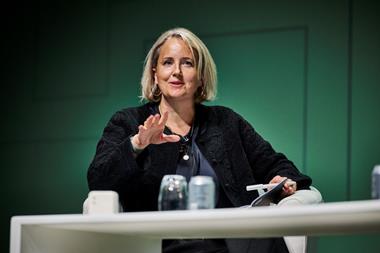








UK pensions minister Torsten Bell has played down concerns that the nation’s Value for Money (VfM) framework could encourage defined contribution (DC) pension funds to “herd” into similar investment strategies, arguing that narrowing the current dispersion in returns would improve outcomes for savers.
Speaking at the Pensions UK annual conference in Liverpool on Thursday, Bell acknowledged that the framework could create incentives for risk aversion but argued that reducing the spread of investment returns would be a positive outcome overall.
“It is a good thing to see a narrowing of the current dispersion in returns,” he said. “If I’m blunt about it, you do want to chop off the bottom of the dispersion. It’s not a good thing to have a very wide distribution of outcomes. That’s what marks the current UK system out.”
Bell acknowledged that the framework would involve trade-offs, saying the key question was whether it could improve on the current system.
“The exam question is: ‘Can we get to a better place than today?’ No, there are never any downsides to anything ever,” he said.
“What matters is what we are overall trying to do with the system. So what are we trying to do that Value for Money can help with and where are there some trade-offs?”
Bell said greater transparency around investment returns was unavoidable but acknowledged that how schemes responded to the framework’s incentives would require careful consideration.
“The honesty bit is where the herding question comes in, lessons from Australia, how people respond to incentives. Those are real things. We should think really hard about those,” he said.
He added that he had discussed the issue “in detail” with regulators as they developed their plans.

Responding to a question comparing potential investment herding to a cycling peloton, Bell suggested that some convergence in investment strategies could be an acceptable, or even desirable, consequence of the reforms.
“You do want a bit of pelotoning,” he said. “What happens overall if there’s a peloton? The average is faster. That is what you’re aiming to achieve.”
However, Bell stressed that pension funds should not simply adopt identical investment strategies.
“We don’t want everyone doing exactly the same thing because people have different members, but also because people should have different views about what’s the right way to deliver the highest returns,” he said.
He also cautioned against judging schemes on individual years of performance, saying returns should be assessed over longer periods.
“We don’t want people over-indexing on individual years of returns. We should be looking at averages over decent periods of time,” Bell said.
Bell acknowledged that assessing schemes on their returns could encourage risk aversion but argued that this risk needed to be weighed against existing weaknesses in investment performance.
“If we get it wrong, there’s some risk aversion built into that,” he said. “But there’s also, let’s be honest, at the moment, some returns that aren’t strong enough. So, peloton away.”
Bell also linked the VfM framework to wider reforms intended to improve DC investment outcomes, including efforts to increase scale, the Mansion House Accord and moves to broaden the range of assets in which schemes invest.
He argued that investment returns were central to building retirement savings, particularly for younger savers, and said the UK needed to focus on returns: “We need to focus on returns.”