





Stefan Beiner, partner at c-alm, explains how geopolitical events can trigger substantial short-term market volatility, noting that their medium-term impact on investment returns is much less predictable
Geopolitical risks have moved to the forefront of many investment discussions. Wars, trade conflicts, sanctions, and shifting political alliances dominate the headlines. Yet most Swiss pension funds have not made major changes to their strategic asset allocation.
Is this restraint justified, or are institutional investors underestimating what geopolitics can do to returns?
A study by c-alm AG offers a starting point. It uses the Geopolitical Risk Index (GPR) [1] developed by Caldara and Iacoviello, which measures geopolitical tensions through automated text searches of coverage in ten leading international newspapers.
Figure 1: Geopolitical Risk Index
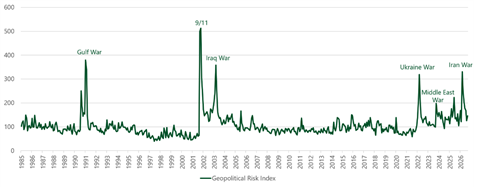
The study examines six episodes in which the index reached extreme levels [2]: the Gulf War, the September 11 terrorist attacks, the Iraq War, the war in Ukraine, the 2023 conflict in the Middle East and the most recent Iran War identified in Figure 1.
Before turning to these extreme events, a simple correlation analysis provides a first impression of the dynamics between the GPR index and a few prominent asset classes [3]. For US Treasuries (−0.06) and gold (0.01), for example, the correlation between monthly index changes and next-month returns is only slightly negative and slightly positive, respectively. Although these values are not far from zero, it seems plausible that the returns of precisely these more defensive asset classes are only weakly correlated with geopolitical risk. The returns of global equities (−0.15), emerging market equities (−0.18) and US high-yield bonds (−0.14), by contrast, all show more clearly negative correlations. More offensive investments thus tend to deliver weak returns in months of rising geopolitical risk.
Given their circumstances, pension funds should keep an eye not only on fluctuations but above all on extreme events. Next, we therefore take a closer look at the six outliers of the GPR index mentioned earlier.
Figure 2: Monthly returns during and one year after a geopolitical event
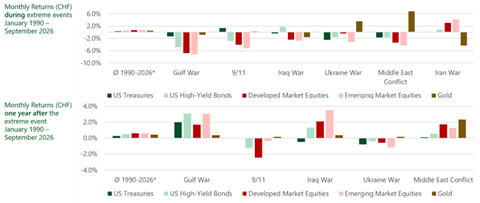
The upper part of Figure 2 shows how the asset classes under review reacted in the short term to extreme geopolitical events. The leftmost group of bars shows the average monthly return over the entire period from January 1990 to September 2026. The following groups of bars show the average monthly returns during the respective extreme geopolitical events.
The short-term findings are largely consistent with expectations. Riskier assets, particularly equities and high-yield bonds, tend to suffer when geopolitical risks escalate. In five of the six episodes, both global and emerging market equities posted negative average monthly returns, with losses of around 7% per month during the Gulf War. US high-yield bonds were negative in four episodes. The traditional safe havens were less reliable. US Treasuries lost money in five of the six episodes, although the loss during the Iran War was only marginal. Only 11 September saw a clearly positive return. Gold gained in three episodes, strongly so in the war in Ukraine and the Middle East conflict, but lost in the Gulf War, the Iraq War and the Iran War. In half of the episodes, neither Treasuries nor gold delivered a positive return. The Iran War is the exception: equities gained, gold lost.
The more interesting part comes after the initial market reaction (lower part of Figure 2). Following the Gulf War, the Iraq War and the Middle East conflict, average monthly returns across the asset classes examined were largely back at their historical levels a year later, in some cases while the conflicts continued. The picture was different following 11 September and the outbreak of the war in Ukraine, but both episodes coincided with significant macroeconomic developments: the aftermath of the dotcom bubble and, in 2022, the inflation shock and rate hikes. The Iran War is not shown in the lower panel, as the 12-month window has not yet been completed.
Geopolitical events can trigger substantial short-term market volatility, but their medium-term impact on investment returns is much less predictable. Isolating the effects of geopolitics from broader macroeconomic developments is inherently difficult. The historical sample of extreme events is small, and geopolitical shocks rarely occur in isolation.
So how much effort should institutional investors put into forecasting geopolitical developments? Anticipating the event itself matters less than understanding how it will affect economic fundamentals and, in turn, markets. Trade restrictions can undermine corporate profitability, disruptions to energy supplies can increase inflation, and higher government spending can influence interest rates and sovereign risk premiums. These effects may persist long after the initial geopolitical shock.
The same chain of reasoning applies to political events. The US midterm elections in early November are not a geopolitical event in the narrow sense, but they show how many steps lie between an event and a market forecast. Different congressional majorities could influence the administration’s ability to implement its trade, tax and spending plans, and with them growth, inflation, earnings and fiscal policy. Each of these links is uncertain, and translating a particular election outcome into a reliable forecast for equity or bond returns is far from straightforward. Even if every link is assessed correctly, investment success is not guaranteed. Financial markets react to developments relative to expectations already reflected in asset prices.

In my experience, geopolitical uncertainty has reinforced the importance of portfolio construction and governance
For tactical asset allocation, this means that reducing equity exposure after a geopolitical shock requires two correct calls: the risk assessment and the re-entry point. The Iran War shows how easily the first one goes wrong: equities gained, gold lost, and an investor who had extrapolated the pattern of the first five episodes would have been on the wrong side. The rapid recoveries after several of the other events show how hard the second call is.
For pension funds, the greater risk may not be geopolitical uncertainty itself, but the temptation to respond to it with poorly timed tactical decisions. Their investment horizon and liability structure generally favour a disciplined strategic approach over attempts to anticipate short-term market movements.
However, this does not mean that geopolitical risks should be ignored.
In my experience, geopolitical uncertainty has reinforced the importance of portfolio construction and governance. Investment committees increasingly ask whether their portfolios are sufficiently diversified or depend too heavily on particular regions, currencies, technologies or supply chains.
These concerns are justified. Geopolitical risks now extend beyond individual military conflicts to include energy security, cyber threats, sanctions and the broader trend towards deglobalisation. Some of these developments may have lasting implications for inflation, economic growth and the correlations between asset classes.
Yet diversification should not become an objective in itself. No single hedge worked every time: Treasuries helped in 2001, gold in the Ukraine War and the Middle East conflict, and neither in the Iran War. Adding investments or reducing geographical exposures purely in response to geopolitical concerns may introduce new risks without necessarily improving portfolio resilience. Funding ratios, liability structures, liquidity needs and risk capacity differ considerably, so a portfolio that is resilient for one pension fund may be unsuitable for another.
Rebalancing is just as important. When equity markets decline sharply during geopolitical crises, portfolio weights may fall below their strategic targets. A rules-based rebalancing framework allows investors to restore these exposures and potentially benefit from subsequent market recoveries. Recoveries are not guaranteed to be quick, as the episodes of 2001 and 2022 showed. Effective rebalancing requires adequate liquidity, clearly defined rebalancing ranges and investment committees willing to follow their own rules when market sentiment is particularly negative. The last point is often harder than designing the strategy itself.
The historical evidence suggests that major portfolio adjustments driven primarily by geopolitical headlines are rarely justified. But structural changes in trade, fiscal policy and supply chains can alter the economic environment in which portfolios generate returns. Such developments deserve consideration in strategic asset allocation and risk management. Scenario analysis can show how a portfolio would perform under different geopolitical and macroeconomic conditions, without assigning probabilities to specific events.
The challenge for pension funds is not to predict geopolitical developments more accurately than other market participants, but to distinguish temporary market disruptions from structural changes in underlying risk and return drivers. This requires a sound investment strategy, sufficient liquidity, and governance that works under stress. Resilience is rarely achieved by predicting the future correctly. It is achieved by building a portfolio that can withstand uncertainty, including the possibility that our expectations prove wrong.
Dr. Stefan Beiner has been a partner at c-alm AG since March 2025 and is also president of the Swiss Society for Financial Market Research.
[1] Source: Caldara, D., & Iacoviello, M. (2022). Measuring geopolitical risk. American Economic Review, 112(4), 1194– 1225.
[2] Events are defined by the level of the index rather than by the calendar. The war in Ukraine, for example, no longer qualifies as an extreme event from April 2022 onwards, even though the war continues: the index captures how strongly geopolitics dominates the news, not how long a conflict lasts.
[3] The following indices are used (in CHF; January 1990 to September 2026): Bloomberg US Treasury, Bloomberg US Corporate High Yield, MSCI World, MSCI EM, Gold Spot. Returns on global equities, emerging market equities, US high-yield bonds, US Treasuries and gold are measured in Swiss francs from January 1990 to September 2026, that is, from the perspective of a Swiss investor.