- Markets were relieved at the temporary resolution of the debt ceiling crisis
- US may be heading for a soft landing as inflation slows down
- UK inflation continues to surprise to the upside
- Turkey has work to do to cut inflation
The US debt ceiling crisis was resolved in June, avoiding potentially major fireworks, with a suspension of the limit until early 2025. This ensures that the next time the politicians have to fight about it will be after the November 2024 presidential election. Although markets were relieved at the temporary resolution, the process of rebuilding the very depleted Treasury cash balances – with some huge bill auctions planned – will drain significant liquidity from the system, which could put pressure on the rates market.
US employment data has continued to beat expectations for jobs growth, for the 14th consecutive month since May 2022’s non-farm payroll print. This time the data was more mixed, with a rise in the unemployment rate, and while still positive, jobs creation has cooled off significantly in the past months.

India looks for ways to boost tax revenues
Successful investing over the medium to long term takes more than luck and is usually always tricky. Investing in India’s financial markets has often tended to be more vexing in than many other domains, despite the economy being one of the fastest growing over the past quarter century.
Though Prime Minister Narendra Modi’s intentions were seemingly sensible, he caused chaos and a great deal of pain to its poorest citizens when he announced on 8 November 2016, with no forewarning, that the currency’s two highest denomination notes – representing over 85% of total cash in circulation – were to be withdrawn from circulation immediately. The move had little impact on India’s large black market, but damaged the country’s reputation as a credible destination for foreign investment.
In late May this year, the Bank of India announced that the 2,000-rupee note was also to be withdrawn, but on this occasion gave much more time for the notes to be exchanged, thus causing less mayhem across the country.
In the past decade India has undertaken some major changes in its efforts to formalise the economy. These include supply-side reforms, real estate regulations, labour reforms, flexible inflation targeting and focusing on foreign direct investment, which has the potential to greatly improve the country’s appeal.
Although falling commodity prices have helped shrink India’s current account deficit over the past 12 months, the trade surplus has also grown significantly, driven in particular by strong services exports, and remittances from workers overseas and students studying abroad.
If India can usher in a period of prolonged macro stability, and further reduce its reliance on short-term capital market flows, and consequently its beta contribution to emerging markets, then India has the potential to attract significantly more foreign direct investment,
India’s public debt rose significantly over the course of the pandemic, and although it has subsequently fallen after two strong years of nominal GDP growth, it currently stands at just over 80% of GDP. The country needs to keep spending on health, education and infrastructure, so India will need to boost its tax revenues and hopefully continue to produce strong nominal GDP growth to stabilise the debt, and to reduce the ratio further.
As US inflation seems to be slowing down, the market narrative has returned to the ‘soft-landing’ outlook. However, with core inflation still high, the Federal Reserve’s pause is best described as hawkish, and more hikes can be expected later this year.
China’s macroeconomic data has been disappointing after a strong first quarter. Consensus forecasts point to continued pessimism and scepticism over the continuation of the recovery. However, with rising spending on services as opposed to goods, perhaps the changing nature of Chinese economic growth could be an important factor behind the current weakness in data.
Most major central banks are still tightening, or at least waiting before hiking more, and the outlook may not be that rosy. The S&P, however, seems to be heading off on another bull run, driven in no small part by the perceived beneficiaries of the artificial intelligence (AI) revolution. Sceptical observers are perhaps looking to Amara’s Law, which suggests that investors tend to overestimate the effect of a new technology in the short term and underestimate its effect in the long run.
BONDS
The debt ceiling resolution has turned the spotlight on the huge amounts of Treasury sales that will be needed to rebuild the Treasury General Account, which would normally contain around $600bn but as the Treasury had been running its cash balance down to avoid the technical default, the balance got as low as $50bn.
It is not clear how this expected deluge of T-bills may affect the rest of the Treasury market. However, it may put upward pressure on rates to entice money market funds to buy all the new debt, which could in turn force banks to increase their savings rates to keep them attractive to existing depositors, reducing market liquidity like a de facto rate hike.
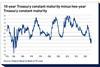
The US 10-year/two-year yield curve was last inverted by this much in the early 1980s. Whether or not this yield curve will prove to be correct in ‘predicting’ a recession in the coming months, the extent of the inversion has not historically had any link to the depth of subsequent recessions, but it is curious that the 10-year rates are quite so much lower than the two-year.
It may be that the yield curve shape is signalling a belief that the US economy will return to conditions experienced just after the global financial crisis, with low growth and low interest rates. In this environment of secular stagnation, the long-term real interest rate remains very low, thus anchoring nominal long-term interest rates.
However, this recovery is different to the post-financial crisis years. Some of the reasons cited for higher term premia and steeper curves are: higher policy rates, persistently high inflation, the enormous fiscal loosening and the replacement of quantitative easing with quantitative tightening.
CURRENCIES
With the debt ceiling worries out of the way, the dollar can regain much of its safe-haven status, particularly against the likes of the Swiss franc, as well as providing generous carry within G10, compared to sterling or the Australian dollar.
Sterling has already been one of the beneficiaries of the sharply lower energy prices. The Bank of England has, arguably, been the least pro-active of the major central banks and has remained on the sidelines for a long time. However, high UK inflation continues to surprise, as the strong labour market pushes wage demands higher.
Analysts have been raising their terminal rate forecasts for sterling, and this factor coupled with the prospect of a Fed on hold, which probably improves overall risk sentiment, may boost the attraction of sterling even more.
In the aftermath of President Recep Tayyip Erdoğan’s re-election in Turkey, the currency has been aggressively selling off. Although the investment community was relieved to see the return of officials, such as finance minister Mehmet Şimşek, the currency weakness better reflects fundamentals.
Inflation is very high in Turkey and is currently standing at 43%, compared with 70% a year ago, boosted by Erdoğan’s previous policies including low interest rates, and low taxes. It is hoped that Şimşek will persuade Erdoğan that interest rates in Turkey should be much higher, nearer 25% compared to today’s 8.5% levels.
With huge imbalances in its current account, Turkey needs to make more significant adjustments and further currency weakness is probably required. However, it is hoped that investor confidence will be sufficiently boosted by Şimşek’s arrival, and that the adjustments in the country’s currency and rates markets will be more measured.