


All IPE articles in December 2014 (Magazine)
Articles from IPE Magazine December 2014.-
Special Report
Special Report – Outlook 2015: Political & Geopolitical Risk
It’s 2014, and geopolitical risk is back. It’s not as if nothing happened since the Berlin Wall came down, but the sudden confluence of a US government shutdown, Russia’s annexation of Crimea, the march of Islamic State and the polling successes of anti-EU parties, not to mention the threatened break-up of the UK, has concentrated minds. Citigroup research confirms there have indeed been more frequent elections and public protests since 2011 than in the preceding decade.
-
Special Report
Special Report – Outlook 2015: A year of eerie calm
While geopolitical activity has picked up markedly, financial market volatility has remained well below long-term averages. Emma Cusworth asks, are investors ignoring a build up of risk, or has the nature of the geopolitical game changed?
-
 Features
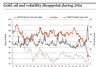
Special Report – Outlook 2015: Fear gauges refuse to budge
One of the defining characteristics of 2014 has been the return of geopolitical risk. For months there has been a constant stream of de-stabilising news from around the globe – from Russia’s annexation of Crimea to the advancement of Islamic State, pro-democracy demonstrations in Hong Kong and the spread of Ebola in West Africa and beyond.
-
Features
Special Report – Outlook 2015: War on Europe’s frontier
The economic and financial impact of Russia’s annexation of Crimea and Ukraine’s ongoing civil strife are mostly limited to the prime actors, writes Daniel Ben-Ami. But the Baltics are also exposed, and risks would be posed to the rest of Europe by an escalation of sanctions or a disruption of ...
-
Special Report
Special Report – Outlook 2015: Giving up freedom for security
Among the many casualties of the financial crisis, perhaps the least heralded but potentially of greatest long-term impact is the modern orthodoxy of central bank independence. Charlotte Moore describes how a new orthodoxy has been written
-
Features
Special Report – Outlook 2015: Monetary politics
Central bank independence is both a recent and a far from universal orthodoxy, notes William White. But the financial crisis has left the world with less of it and the likely further erosion could have significant long-term consequences.
-
Features
Special Report – Outlook 2015: Taxing times for investors
A crackdown on multinational tax avoidance could have significant impact on corporate strategy and portfolio investment theses, writes Anthony Harrington
-
Asset Class Reports
Investing In Hedge Funds: About turn for top-down
Macro, the darling of the hedge fund world through the drama of 2008-09, has struggled in the subsequent low-volatility, low-rates environment. Joseph Mariathasan asks whether recent outperformance signals a more conducive backdrop for this family of strategies
-
Features
Briefing: Pensions Accounting, Back to basics
The International Accounting Standards Board has revealed plans to issue a due process document on the future of pensions accounting. Stephen Bouvier asks where this might lead
-
Country Report
How Swiss funds have achieved transparency
As part of the structural reform, §48a fig. 3 of the BVV law governing Pensionskassen investments was put in place to raise transparency in the reporting of asset management costs in the second pillar.
-
 Features
From Our Perspective: Ready for action
Industry figures like Roger Urwin of Towers Watson have long advocated that pension funds should use their fee budget effectively according to their size and scale, perhaps foregoing costly alternative strategies in favour of recruiting in-house staff.
-
Opinion Pieces
Guest Viewpoint: “Asset owners and managers need to address the problems in the investment industry and focus on value for the ultimate beneficiaries”
We need to move on from today’s investment world, which essentially has been built by intermediaries for intermediaries. Their purposes have become too narrow and too self-centred to be of sustainable value to asset owners, who are charged with transporting and growing savings across time – affordably, securely and fairly.
-
Opinion Pieces
Research: Ageing demographics are an asset allocation game changer
Two of the four worst bear markets of the last century rocked the world of investing over just seven years in the last decade. They sidelined conventional wisdom on risk premia and diversification.
-
Features
Ahead of the Curve: Europe is the new China
George Saravelos sees ‘euroglut’ – and consequently one of the biggest capital outflows in history as excess savings flee aggressive ECB easing, sending the euro plunging against the dollar.
-
Features
Asset Allocation Fixed Income, Rates, Currencies: The big picture
When the Fed embarked upon its first round of quantitative easing five years ago, there were fears of an inflation time bomb. The Fed has already purchased its last lot of Treasuries under QE3, but is still executing regular MBS purchases, as forward inflation expectations in the US and Europe are as low as they have been for years.
-
Interviews
On The Record: Publica, Switzerland Stefan Beiner Head of asset management and deputy CEO
The major concern remains the low interest rate environment. We do not believe rates will increase as fast as in other cycles. The valuation on fixed income in general is rich, and equities are also valued on the high side, depending on the region. It is really difficult to hide right now. I am not that optimistic for the mid-term future, and therefore our internal expected returns are quite low for the next three years.
-
Interviews
Strategically speaking: Assicurazioni Generali
It has been just over two years since Generali CEO Mario Greco took the reins of a company whose governance was in disarray, and whose performance was reflected in a loss of almost 75% of its stock-market value. His appointment immediately stemmed those losses, and the market has since been proved right.
-
Interviews
On The Record: Veritas Pension Insurance Company, Finland, Niina Bergring CIO
The growth divergence between the US and Europe, and the different behaviours of the respective central banks, will simply mean two things: that the euro will be even weaker than it is, and that interest rates will be rigged for even longer in Europe than in the US.
-
Features
Interview, Gabriel Bernardino: We are listening
Gabriel Bernadino, chairman of EIOPA, tells Taha Lokhandwala why his organisation wants stakeholders to challenge the ideas in its consultation on regulatory frameworks
-
Book Review
Book Review: Exploding the fairy tale
Essays in Positive Investment Management, Pascal Blanqué,