
Germany’s financial supervisor BaFin has urged the European Commission to keep the IORP II Directive simple following its ongoing review, which the authority considers unnecessary.
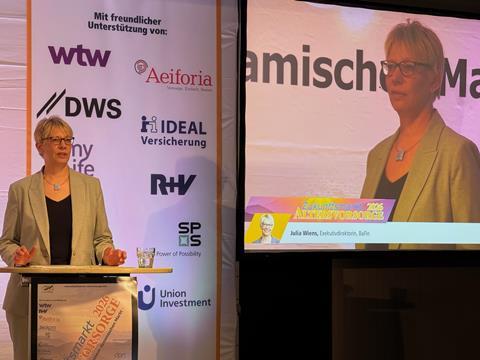
Julia Wiens, executive director for pension funds oversight at BaFin, said it was of “utmost importance” that the directive retains “its minimal harmonisation character”.
“This also means that there should be no Level 2 or Level 3 regulations,” she added, speaking at the Zukunftsmarkt Altersvorsorge event this week in Berlin.
Level 2 and Level 3 rules refer to technical standards and supervisory co-operation measures used to implement EU directives, which Wiens argued were not needed in this case.
BaFin expects any revision of the directive to impose only a minimal bureaucratic burden on occupational pension schemes and supervisory authorities. However, Wiens said the current draft does not yet sufficiently address the need to cut red tape.
“For us, it is truly important to retain the possibility of maintaining national quantitative investment regulations”, easy to implement in practice but not replacing effective risk management of investments, she added.
She stressed that robust risk management remains essential, particularly for pension funds with significant exposure to alternative assets that must meet regular pension payments.
BaFin is currently revising its own investment requirements to remove redundancies and make parts of the framework more principle-based.
Market corrections and illiquidity risks
BaFin has also analysed risks facing occupational pension schemes, particularly in relation to alternative investments.
The supervisor has observed inconsistencies in how limits are applied, with some pension funds lacking specific caps for alternatives, while others classify assets such as private debt under fixed income.
“Given the different risks involved, this is obviously unacceptable,” Wiens told the audience, also warning of mounting financial market risks, describing capital markets as “fragile”.
“It’s only a matter of time before we see significant corrections. Or to put it more bluntly: before the markets crash. At the same time, the number of insolvencies is rising, and with it, the default rates on corporate loans,” she added.
Reform outlook and participation gaps
Panellists at the event also discussed ongoing occupational and private pension reforms expected to have a broader impact on Germany’s pension system.
BaFin welcomed the extension of the social partner defined contribution model to employees not covered by collective bargaining agreements, part of the second-pillar reforms in force this year.
“This form of occupational pension allows for more profitable investment options and thus higher company pensions. Changes to the structure of buffers also make defined contribution plans more attractive,” Wiens said.
Monika Queisser, head of social policy division at the OECD, said Germany does not fare badly when it comes to workers’ voluntary participation in occupational pension funds, while the number of those signing up for private pensions is significantly less than in countries such as Poland, the Czech Republic or Iceland.
The OECD expects discussions and implementation of reforms to consider costs in order to keep people’s trust in the pension system intact, Queisser said.