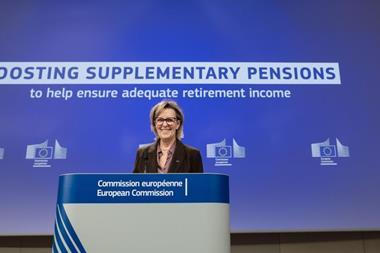
The supplementary pensions package published by the European Commission in November was not focused enough on supporting EU countries in developing national occupational pension schemes in line with diverse national industrial relation practices, according to the European employers’ body, BusinessEurope.
It suggested more use could be made of well-functioning national models as inspiring examples and called on the Commission to create a “community of practice” of those interested in developing the spread of occupational pensions at the national level.
According to BusinessEurope, this should involve the Commission’s financial services and employment departments as well as national governments and social partners.
The suggestion is reminiscent of one made by a constellation of national pension industry groups that are calling for greater recognition and support of a social partner-based model of occupational pensions, which they have dubbed the Rhineland model.
According to BusinessEurope, such a “community of practice” could be supported through resources at EU level to support national labour market reforms in the context of the technical support instrument (TSI) and the financial instruments that will be introduced to replace TSI in the EU budget for 2028-2034.
The TSI is the EU programme that provides technical expertise to EU countries to design and implement economic and social reforms.
The Commission has previously been applauded for plans to integrate Savings and Investment Union (SIU) measures into the European Semester, which is an annual cycle of economic and fiscal policy coordination within the EU that can influence budgetary and economic policy decisions of member states.
‘Regulatory coherence, proportionality’
According to BusinessEurope, the Commission’s November pensions package can support the objectives of the SIU by facilitating long-term investment by pension funds, as long as “regulatory coherence, proportionality and legal certainty are ensured”.
It said it was concerned about a “cumulative administrative burden” stemming from multiple EU initiatives affecting pensions, and that there should be “a clear commitment to simplification and burden reduction, in line with the EU’s competitiveness agenda”.
Specifically with regard to the proposed changes to the IORP II Directive, BusinessEurope said they must not “result in excessively detailed information requirements that provide little added value to beneficiaries while burdening employers”.
It said it strongly opposed the introduction of binding EU-level requirements, such as minimum efficient scale or harmonised quality standards, because such measures would “create consolidation pressure, undermine well-functioning small and medium-sized IORPs and move the Directive towards full harmonisation, which is incompatible with national labour-law integration and the diversity of occupational pensions”.
“While the objective of increasing transparency is welcome, there is a risk that benchmarks could become de facto performance targets, influencing management decisions in ways that may not align with members’ best interests,” said BusinessEurope.
PEPP
Its position paper also included comments about the Commission’s proposal to reform the Pan-European Personal Pension Products (PEPP) Regulation, saying it was essential to maintain a clear distinction between personal and occupational pensions.
It said that adapting PEPPs for occupational or workplace settings was unlikely to deliver tangible improvements in terms of coverage, adequacy, or efficiency and could actually be counterproductive, fragmenting collective arrangements between social partners.
“It is therefore essential that the design and implementation of auto-enrolment mechanisms do not interfere with existing occupational pension schemes or blur the distinction between second pillar and third pillar pension arrangements,” it added.
In a 2024 staff paper, EIOPA suggested the introduction of automatic enrolment in a pension product for all European Union citizens.