





Dutch pension funds were net sellers of US assets last year, reallocating capital towards Europe, according to figures from regulator DNB.
On balance, funds sold €30bn of US equities and bonds, while purchasing €23bn of European securities.
In 2025, pension funds sold €18bn of US government and corporate bonds and €12bn of equities. The decline was largely driven by civil servant scheme ABP, which divested more than €10bn of US government bonds.
While US debt securities were predominantly sold, flows into European fixed income moved in the opposite direction.
Pension funds purchased €20bn of German and Spanish government bonds, while reducing exposure to French sovereign debt. They also acquired €7bn of European corporate bonds, with issuers in France and the Netherlands particularly favoured.
Rebalancing
ABP was not alone in reassessing US allocations. Catholic clergy scheme Bisdommen reduced its exposure to US equities by 10 percentage points over the year.
In total, pension funds sold €12bn of US equities in 2025. However, the shift was not limited to US assets. Funds also sold €5bn of European equities as part of broader portfolio rebalancing.
Strong equity market performance in recent years had increased the relative weight of equities versus bonds, prompting funds to restore balance. Given their comparatively high exposure to US equities, this asset class accounted for the largest share of disposals.
Global shift in sentiment
A reduced appetite for US investments is not limited to the Netherlands, according to a global survey of pension funds and other institutional investors by asset manager Nuveen.
Among the 800 respondents, with combined assets of $16.6trn (€14.4trn), 57% said they plan to reduce US exposure. Europe is emerging as a key destination, with 36% intending to increase allocations to the region.
This trend is not confined to European investors, with a majority of US-based respondents also indicating plans to scale back domestic investments.
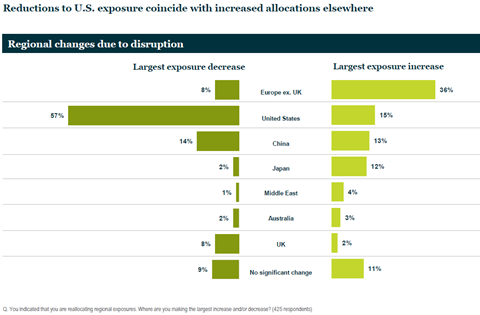
Survey responses point to weakening confidence in the US outlook. Nearly half of respondents expect the dominance of US capital markets to decline over the next decade, compared with 29% who disagree, although US-based investors are more optimistic.
In addition, 44% of participants said that the Trump administration’s trade policy will have “long-lasting consequences” for their investment strategy.