





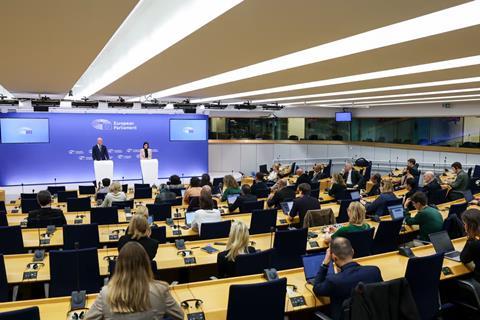
European Parliament has today approved sweeping cuts to the EU’s sustainability laws.
Members of European Parliament (MEPs) voted in favour of a proposal to vastly reduce the scope and substance of the Corporate Sustainability Reporting Directive (CSRD) and Corporate Sustainability Due Diligence Directive (CS3D).
In a move that could mark the start of a new set of political alliances, the centre-right European People’s Party (EPP) formed a majority with MEPs on the far-right – many of whom oppose the EU as an institution – instead of those on the centre-left, as has been traditional.
“Counting on the votes of the far-right is simply surrendering the EU to those that want to destroy its institutions, its joint defence and energy security policies, and want to roll back the EU’s competitive advantages on decarbonisation,” said Julia Otten, a senior policy officer at law firm Frank Bold.
The result means Parliament will demand aggressive reductions to CSRD and CS3D during upcoming negotiations to revise the two laws through a so-called ‘Omnibus I’ package.
While CSRD currently applies to European firms with more than 250 employees and €50m in annual turnover, Parliament will seek to raise the threshold to 1,750 employees and €450m in turnover.
Meanwhile, the European Commission and Council have both proposed a threshold of 1,000 employees.
On CS3D, both Parliament and Council want the threshold to rise from 1,000 to 5,000 employees.
Council is seeking to water down the requirement for companies to have climate transition plans under CS3D, but Parliament will push for its deletion entirely.
Negotiations between the three bodies are expected to commence next week, in a bid to reach a final decision by the end of the year.
“This is going to be the model for rewriting all the EU’s green regulation,” said Richard Gardiner, head of EU policy at sustainable finance NGO ShareAction.
“The Commission will table a proposal and hand it over to the parliament, so it can be redesigned by the far right.”
ESRS and Taxonomy
Parliament also has the power to veto proposed revisions to the European Sustainability Reporting Standards (ESRS), which are currently being finalised by the Commission’s advisory body, the European Financial Reporting Advisory Group (EFRAG).
EFRAG is proposing reductions to the ESRS that would remove 57% of the mandatory data points, in order to make them less burdensome for businesses.
But Gardiner said that may not be sufficient to satisfy Parliament.
“The Commission will be under huge pressure to reduce them further, or risk a veto from the same right-wing coalition that has dictated today’s vote,” he told IPE.
The Commission published a long-awaited ‘quick fix’ law for the ESRS this week, which allows Europe’s largest companies to omit a number of disclosures from their CSRD reports – including the financial effects of sustainability – while the directive is being redesigned.
It also allows some companies to omit information about their Scope 3 emissions.
The Commission has also kicked off a call for evidence to help it revise the climate and environmental delegated acts of the EU Taxonomy.
It is asking for feedback until 5 December.
Read the digital edition of IPE’s latest magazine