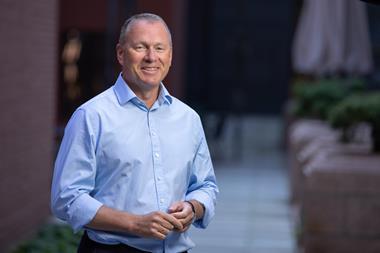

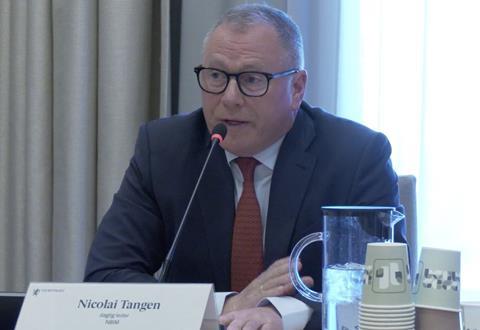
Nicolai Tangen, chief executive officer of Norges Bank Investment Management (NBIM), told lawmakers in Oslo today that booming development in artificial intelligence (AI) technology has caused unprecedented equities concentration in the sovereign wealth fund, which may become even more exaggerated.
At the annual parliamentary hearing on the SWF, Tangen focused his speech particularly on AI, and said: “There is a concentration risk around a few companies that we have never seen before in the fund’s history. And it may continue to increase.”
He said: “Artificial intelligence is, in my opinion, the most important thing happening in the world at the moment.”
“And the development of this technology is progressing more strongly than we have ever seen before,” he noted, adding that he was hearing this personally from top leaders around the world.
“They are using the expression ‘red alert’. I don’t think that we in Norway have really taken this into account,” said the leader of NBIM, which runs the NOK20.4trn (€1.9trn) Government Pension Fund Global (GPFG).
Tangen said the development of AI was affecting NBIM in different ways – one being how the Oslo-headquartered organisation used AI tools internally. All NBIM staff now use the tools, he said, adding that more than half of them used coding tools and were active with code.
“Between 2020 and 2025, using different tools, and AI being part of that, we have reduced our trading costs by almost NOK5bn,” he stated.
“Between 2020 and 2025, using different tools, and AI being part of that, we have reduced our trading costs by almost NOK5bn”
Nicolai Tangen, CEO of NBIM
Over the last five years, he said, the GPFG had earned NOK1.6trn in returns from the seven largest US technology companies.
Meanwhile, Norwegian finance minister Jens Stoltenberg warned the parliamentary hearing about the fund’s increasing concentration around the seven biggest US technology companies — Nvidia, Alphabet, Apple, Meta, Amazon, Tesla and Microsoft — and said 10% of the fund’s return now came from this small number of businesses.
“That concentration has served us well, but that concentration also gives us a great risk,” he said.
“Hardly anyone has profited more from the AI revolution, artificial intelligence, than Norway. But hardly anyone is more exposed to the uncertainty that the enormous share values also represent,” Stoltenberg continued.
The finance minister said 54% of the GPFG’s overall portfolio - including bonds - was now invested in the US.
Stoltenberg referred fellow parliamentarians to the 2026 annual white paper on the SWF – the GPFG as well as the smaller Government Pension Fund Norway (GPFN) –which was published at the end of March.
The report mentions the ministry’s recent request that Norges Bank analyse and assess concentration risk in the equity portfolio, as well as aspects of the bond investments, and works on scenarios for geopolitical risk.