
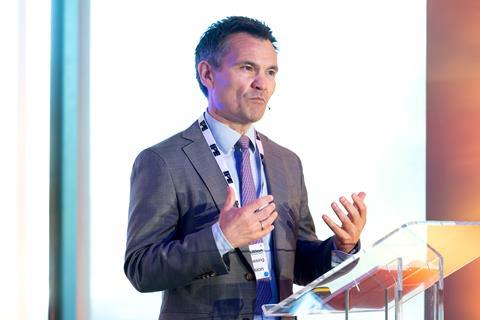
European pension funds should use ESG frameworks to strengthen oversight of defence investments rather than pretend the sector is free of ethical risk, according to Rasmus Bessing, co-chief investment officer, responsible investments and investment products at PFA.
Speaking at IPE’s Transition Conference in The Hague last week, Bessing said the Danish pensions provider had developed a new framework for assessing defence holdings after reviewing its policy in the wake of Russia’s invasion of Ukraine.
“ESG in this context is not really about pretending defence is a clean industry,” he said. “It’s more about creating a robust framework for being an institutional investor who responsibly invests in the defence system.”
His comments come as asset owners across Europe are reassessing defence exclusions amid stronger returns from arms companies, increased geopolitical risk and political pressure to support European rearmament.
Some investors have lifted blanket bans on defence companies, while others have tightened their policies or retained exclusions, reflecting a split in the market over how far fiduciary duty and sustainability commitments should accommodate weapons exposure.
Bessing said PFA’s own approach was shaped by both societal and financial considerations. He said Europe’s security situation had changed materially since 2022, creating a need to “protect democracies” and “our way of life”, while defence companies had also benefited from a structural shift in European spending.
PFA has increased its exposure to defence in its main fund, while keeping its dedicated climate fund free of defence investments. Bessing said that, in his view, “it’s responsible to invest in defence, but it’s not necessarily sustainable”.
The pensions provider reviewed its investment universe and started assessing defence companies using a dedicated ESG risk framework. This includes scrutiny of governance controls, exposure to controversies, corruption risk, procurement ethics, human rights due diligence and alignment with international norms.
Stewardship, end-use risk
Bessing said PFA had begun engaging with companies in the portfolio to understand their business models and where risks arise.
“It’s not an industry that is very used to having a lot of institutional money,” he said, adding that dialogue with defence companies can be different from other sectors because of confidentiality and state contracts.
One of the most difficult issues for investors is end-use risk, including whether products are deployed in conflicts investors would not want to be associated with, or sold to buyers that do not follow international norms.
“We need to think about where the products end up throughout the lifespan,” Bessing said. “Are they used in conflicts that we are not happy with? Are they used in a way with buyers who do not adhere to the international norms that we believe in?”
Asked about the risk of complicity in controversial conflicts, he said PFA applies additional scrutiny to company processes and export controls, but acknowledged the challenge.
“It is definitely a dilemma,” he said. “It’s not a clean sector. It’s not without dynamics.”