
- Defence companies are booming, making it harder for investors to justify exclusions
- Many argue that current geopolitics make some weapons a socially-responsible investment
- Asset owners are taking different positions, from ditching all screens to introducing stronger ones
When Norges Bank Investment Management (NBIM) published its most recent responsible investment report, it contained an admission.
“Product-based exclusions have reduced the cumulative return on the equity benchmark index by around 3.51 percentage points or 0.04 percentage points annually,” wrote the world’s largest asset owner in February.
On the basis of guidance from its ethical committee, NBIM is prohibited from investing in companies providing certain products and services, including tobacco and weapons.
“It is mainly the exclusion of weapons manufacturers that has reduced returns,” it noted.
Big names like BAE Systems, Airbus, Lockheed Martin, Safran and General Dynamics are among those currently deemed off limits, and – as armed conflict flares up across the globe – that means missing out on their booming profits.
Star performance presents a dilemma
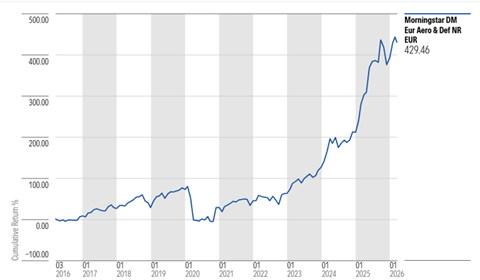
“Alongside artificial intelligence, defence has been one of the strongest investment themes of recent years,” explains Kenneth Lamont, a principal at Morningstar.
“Over the trailing 10 years, global equities returned 198% while global defence stocks returned 320%, with the majority occurring after the conflict in Ukraine.”
The strongest performance has come from Europe, where – at the time of writing – defence names had grown by 250% since early 2022.
Both US and European defence stocks were up around 10% so far this year.
This star performance drove the number of thematic defence funds to nearly double by the end of 2025, reaching 30, and net inflows reached close to €2.5bn over the first two months of 2026 – taking total assets to a record €29.5bn.
Weapons as a socially-responsible investment
In addition, politicians and citizens across Europe are keen to see the region strengthen its defence industry, which has turned weapons into a socially-responsible investment in the eyes of many asset owners.
In the case of NBIM, the Norwegian parliament has commissioned a review of the fund’s ethical guidelines to better align them with national interests. A final decision is expected next year.
Others have responded more swiftly.
“We observed a change in the views of both our institutional clients and our pension clients since the invasion of Ukraine”
Johan Sjöström, head of business at KPA Pension
Danish pension fund PFA lifted its exclusions of large European arms companies in 2022, and says its defence investments returned 371% in the 34 months that followed, versus 38% for the broad World Index.
“We don’t think we will see such high increases in the next few years,” PFA’s responsible investment director Rasmus Bessing wrote in a blog at the time.
“But on the other hand, the great focus on European armament is something that will last several years into the future.”
In Sweden, KPA Pension has also lifted its exclusions.
The SEK300bn (€28bn) Folksam subsidiary has had a blanket ban on defence-related companies in place since it was established in the 1990s.
“But our position was becoming increasingly out of step with peers, including the local government bodies whose pension schemes we run,” says Johan Sjöström, KPA Pension’s head of business.
“When it comes to the security situation for Europe – especially for Sweden – we’ve observed a change in the views of both our institutional clients and our pension clients since the invasion of Ukraine, and we wanted our exclusion policy to reflect that.”
KPA has more than two million customers, so getting consensus would be impossible, but Sjöström says the fund spent “a couple of years” in dialogue with stakeholders, as well as working closely with its responsible investment and risk teams, to come to a final position.
“Our new policy means we no longer categorically exclude the defence industry,” he tells IPE, although controversial weapons are still out, and the ESG screens it applies to all of its other holdings still stand.
“It’s more about assessing risks now, and allowing defence investments to be considered within quite clearly-defined ethical boundaries rather than automatic exclusions,” says Sjöström.
“We think it’s a more nuanced approach.”
And nuance seems to be the name of the game.
Denmark’s AkademikerPension has lifted exclusions on nine companies with links to nuclear weapons in Europe recently, but in March its responsible investment committee added four others to its blacklist, citing their potential involvement in US and Chinese nuclear programmes.
The Church of England’s ethics committee provided updated guidance on defence to its two asset-owner bodies last year, prompting different responses.
The Church’s £3.2bn pension fund responded by tightening its rules, so it now excludes firms generating more than 5% of revenues from defence. The threshold was previously 10%.
Its endowment, on the other hand, softened its quantitative rules.
“We previously had a blanket approach – a 10% revenue threshold for companies ‘enhancing combat effectiveness’,” explains Dan Neale, a former conflict-stabilisation specialist with the British military, who now heads up social issues for the Church Commissioners for England.
“It was very binary: companies were in or out, they were ‘good’ or ‘bad’.”
“But when you draw fine lines like that, it means you can invest in a massive conglomerate that makes 9% of its money from selling missiles, but you can’t invest in a UK clothing manufacturer that makes 12% of its money selling uniforms to the Ministry of Defence,” he points out.
As a result, the endowment fund now spends more time considering the context in which a company is operating – what it sells, and to whom – rather than just revenue thresholds.
It’s also convening investors and subject matter experts to help establish an approach to downstream aspects of defence, such as the design, development, sale, export, use and misuse of weapons, and the influence that arms companies have.
The output will take the form of Guidance for Responsible Investment in Defence-related companies, or GRID.
“The GRID Steering Group is now focused on creating the first draft of the Guidance document, which will be consulted on over the summer, with an aim for an autumn launch of the final version,” Neale tells IPE.
Schroders, Amundi, Skandia and LBP Asset Management have all been confirmed as participants, with more investors – from Europe, North America and Asia Pacific – to be announced over coming months.
Some pension funds are divesting more, not less
Not all investors are embracing the trend, though.
In March, London’s Waltham Forest Pension Fund announced it would be pulling out of defence completely.
Following a preliminary decision in 2024 to divest from companies generating 5% of revenues from arms – as defined by S&P’s Paris-Aligned & Climate Transition indices methodology – the local authority asked its investment advisers to assess the financial implications.
The details of that assessment haven’t been made public, but a spokesperson said it found the policy “would not have a significant detrimental financial impact on the Waltham Forest Pension Fund”.
As a result, the fund wasn’t obliged to canvass its members, and has asked its asset manager, London CIV, to move ahead with setting up subfunds with other local authority clients.
In a statement published at the time, local politician and chair of Waltham Forest’s pension committee, Johar Khan, described the decision as “a moment of real pride”.
“We won’t stop here,” he said. “We’ll continue to push for further exclusions to ensure that investment decisions are aligned with globally-recognised principles on human rights and humanitarian law. We are building a framework that reflects not just where we are today, but where we believe responsible investment must go in the future.”