








Key points:
- There has been a wide gap between the rhetoric and reality of the UK’s pension freedoms
- One area is guidance support and the other is investment solutions
- Government and regulators have moved to make sustainable retirement income easier to access
- Both areas have the potential to improve retirement income outcomes
“Nearly half of the pension pots accessed for the first time are still fully withdrawn as cash”
The pension freedoms introduced in the UK in 2015 replaced the effective requirement to buy an annuity with broad choice over how defined contribution savings are used. From age 55, rising to 57 in April 2028, retirees can take up to 25% tax free and use the balance for an annuity, flexible drawdown, phased lump sums or a full withdrawal subject to tax.
Pension freedoms turned retirement from a one-off annuity purchase into an ongoing risk-management exercise, requiring individuals to make complex decisions about income, investment and longevity. In practice, many retirees have neither the support nor the engagement needed to manage those decisions confidently.
Unintended consequences
Indeed, the experience of the accumulation phase in DC plans shows that, left to their own devices, plan members often tend to stick to their initial asset allocation, even as and when their situation changes. They display strong inertia and dislike choice overload, according to a new report from Allsping Global Investments and CREATE-Research, titled “Defusing the DC retirement income time bomb”.
The report shows that just over two-fifths of retirees will be at high or medium risk of making poor decisions. Nearly half of the pension pots accessed for the first time are still fully withdrawn as cash. Among the rest, more than three times as many retirees opt for phased drawdowns to fund their retirement rather than choose an annuity. The most commonly reported annual withdrawal rate is 8% or higher, well above the level often used as a starting point in retirement-planning analysis. Sustained withdrawals at this level can materially increase the risk of retirees exhausting their pension assets, particularly when combined with adverse early investment returns.
Even where pension savings are intended to generate a sustainable income, relatively few retirees seek regulated advice. In practice, many retirees have followed the path of least resistance, potentially leaving them with less sustainable retirement outcomes.
The Pension Schemes Act 2026 places Guided Retirement duties on trustees and managers, requiring one or more default pension solutions to be made available. The FCA must set corresponding rules for FCA-regulated workplace schemes. This scheme-level framework sits alongside the FCA’s Investment Pathways for non-advised drawdown customers and its targeted-support regime for groups of consumers with common characteristics. Together, these measures aim to improve access to sustainable retirement income without removing freedom of choice.
Guidance support
Support now operates at several levels. Investment Pathways give non-advised drawdown customers a limited set of objective-based choices. Targeted support fills part of the gap between generic guidance and paid advice by allowing firms to make suggestions designed for groups of consumers with common characteristics, rather than personal recommendations based on a full individual assessment.
Financial education remains important, but the aim is not to turn retirees into investment experts. It is to help them understand what a retirement portfolio is intended to do, recognise the main risks and trade-offs, ask better questions and monitor whether the chosen approach remains suitable.
Retirement income solutions
There is no universal retirement solution. An annuity can convert part of the DC pot into secure lifetime income, but the capital committed is no longer accessible. Drawdown preserves flexibility and growth potential but leaves the retiree exposed to market movements and the risk of running out of income. Cash provides immediate access but is unlikely to support spending over a long retirement. The practical question is therefore how to divide the DC pot among secure income, a liquid reserve and growth assets.
To explore how different household circumstances affect the appropriate retirement mix, we modelled four illustrative retiree personas with different levels of DC wealth, secure pension income and spending needs. For each persona, we tested alternative ways of dividing the DC pot among secure income, liquidity and growth assets across 10,000 simulated retirement paths. The allocations were assessed primarily on their ability to protect essential spending in adverse outcomes, with discretionary spending and residual wealth considered where essential needs were met.
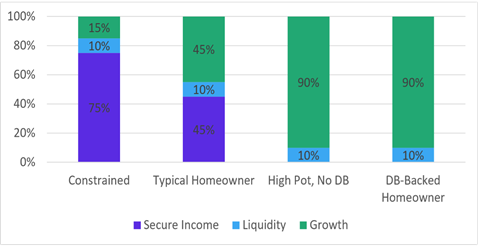
Figure 1. How retirement needs change the balance between security, liquidity and growth
Model-indicated allocation by persona
Source: Allspring Global Investments.
Allocations are illustrative model-indicated starting points, not personalised recommendations
Figure 1 shows the allocations indicated by this exercise. The model retains 10% in liquidity for each persona as a reserve for near-term spending and unexpected costs. The remaining allocation depends principally on the relationship between essential expenditure, existing secure income and the financial resources available to close any gap.
Where essential spending is underprotected and the household has limited capacity to absorb market losses, the model assigns more of the pot to secure income. Where essential spending is already better supported, or the household has sufficient wealth to bear investment risk, more capital can remain invested for flexibility and growth. This explains the progression across the chart.
The Constrained and Typical Homeowner personas both have an essential-income gap, so each uses part of the DC pot to strengthen the income floor, although the Constrained persona requires a substantially larger allocation.
The High Pot, No DB and DB-backed Homeowner both retain 90% in growth assets, but for different reasons: the former has sufficient financial wealth to absorb market risk, while the latter already has substantial secure income from its DB pension.
The results are model-indicated starting points rather than personalised recommendations. They also underline an important limitation: a better allocation can improve resilience, but it cannot solve an underlying shortage of retirement resources.
A resilient drawdown portfolio
Portfolio decisions in decumulation are fundamentally different from accumulation. Regular withdrawals make the sequence of returns critical because assets sold during a downturn cannot participate in the subsequent recovery.
A retirement portfolio should therefore be judged partly by how well it sustains withdrawals and preserves capital through difficult return paths, rather than only by its average return or familiar risk label. Here again a new approach is coming into view.
A time-honoured 40% equity and 60% high-quality bond portfolio remains a sensible starting point, but it is not a complete solution. Equity losses are particularly damaging when they coincide with withdrawals. Inflation can erode the real value of bond income. Bonds do not reliably diversify equities in every environment, particularly when rising inflation causes the two asset classes to fall together.
Our modelling favours a progressively augmented growth/drawdown portfolio, comprising high-dividend equities, systematic downside-risk management via put replication, liquid alternatives and commodities. Each addresses different vulnerabilities, like inflation, large equity falls and prolonged market weakness.
The aim is not to predict which strategy will work next, but to reduce reliance on any one market environment or diversification relationship. High-dividend equities and systematic downside-risk management are intended to improve the path of equity returns, while liquid alternatives and commodities add return sources that need not depend on favourable equity and bond markets.
A credible starting point
Taken together, the reforms and emerging retirement solutions could narrow the gap between the promise and practical reality of pension freedoms.
Guided Retirement defaults, Investment Pathways and targeted support offer more structured routes through decumulation, but their impact will depend on scheme design, governance, implementation and the circumstances of individual members.
These measures cannot eliminate poor outcomes or replace personalised advice where it is needed. They can, however, provide more credible starting points and clearer guardrails, while preserving member choice and encouraging retirement strategies to be reviewed as needs and market conditions change.

Matthias Scheiber (left) is head of multi-asset solutions at Allspring Global Investments, and Amin Rajan is CEO of CREATE-Research and a member of The 300 Club