






By 2063, Australia’s relatively youthful treasurer, Jim Chalmers, will be 85 years old and likely well into retirement.
Like most of his contemporaries, Chalmers’ retirement will be self-funded from his pension savings accumulated over the next decades.
This year, Australia has set aside some 2.3% of the Federal budget to boost Australians’ retirement incomes through the age pension.
But that number will lessen over the years. Despite a rapidly ageing population, four decades from now the government of the day should need to spend just 2% of its budget on the age pension.
This is well below the average across OECD countries, where public pension expenditure is projected to increase to 9.4% of GDP in 2050, according to the Australian Institute of Super Trustees.
Chalmers recently handed down Australia’s latest five-year Intergenerational Report (IGR). Apart from the good news on projected pension spending, it offers an otherwise depressing outlook for the Australian economy over the next four decades.
The IGR projects the story of an older Australia weighed down with slower economic growth and a higher tax burden for younger generations facing wage growth that is half that enjoyed over the past 40 years.
The IGR, first published in 2002 by the previous treasurer, Peter Costello, aims to provide a snapshot of how the Australian economy will look in the years ahead. It is designed to provide key goalposts for policy setting to meet the changing social and economic dynamics of the country.
Unfortunately, but not unexpectedly, such a report is bound to be coloured by the politics of the day.
The key takeaways of the sixth IGR are that gross national income growth will slow; life expectancy is set to grow; population growth will slow; the working population will shrink; and personal taxes are set to rise.
Critics have dismissed some of the projections as “dodgy”, while conservative commentators have slammed the report as lacking in reforms that will increase productivity and lower the tax burden.
“This year, Australia has set aside some 2.3% of the Federal budget to boost Australians’ retirement incomes through the age pension”
Flows of superannuation money
Superannuation success
The high point of the IGR is the success of the Labor-inspired superannuation system. Australia’s saving pool is expected to double from today’s A$3.5trn (€2trn) to A$7trn. But the challenge is to persuade Australians to spend their savings and not hoard them to give away as an inheritance.
The question of cost around tax concessions for superannuation earnings will continue to haunt whichever political party is in office for years to come. These costs will rise from around 1.9% of the budget today to 2.4% by 2063 – and are projected to overtake age pension expenditure in the 2040s. So it is a balancing act of how much tax revenue the government should forego to continue to encourage savings for retirement.
The report accepts that tax concessions are “significant” but says they provide incentives to save for retirement and allow for greater growth of those savings.
There is also the issue of gender gap. In 2021-22, the average super balance for men was A$190,000 compared with A$150,000 for women. With more women in the workforce, the gender gap will narrow but remain.
Opposition Treasury spokesperson Angus Taylor says the report reveals Labor’s “true plan for a big Australia, with higher taxes, higher spending and deficits” for the next 40 years.

When asked to comment, former treasury secretary Ken Henry describes the report as “an intergenerational tragedy” because of the forecast scenario in which income tax would constitute an increasing share of the tax take over time.
The government and the super industry see it differently.
The IGR vindicates the decision to introduce universal superannuation in 1992 as one way of offsetting an expected increase in age pension spending as baby boomers move off employment into retirement, they say.
With the fourth-largest retirement saving pool in the world, working Australians are certainly accumulating a nest egg to fund life in retirement.
By the mid-2040s, most people retiring will have a higher superannuation balance because they have received the super guarantee for a longer portion of their careers – and at a higher rate.
Chalmers himself was just 14 years old when Australia’s compulsory superannuation system came into being. His entire working life has been covered by the superannuation guarantee, currently at 11% of salary, rising to 12% by July 1, 2025.
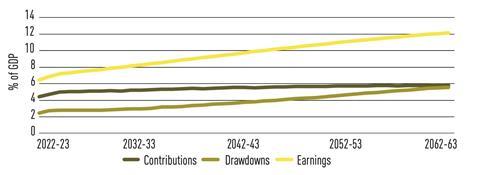
As balances increase, super will become the primary source of retirement income for many future retirees. Drawdowns from super are estimated to increase over time from around 2.4% of GDP in 2022-23 to 5.6% of GDP in 2062-63.
The proportion of people with accounts in the retirement phase, from which they are drawing a super pension, will increase from 8% today to 19%. By comparison, the proportion of the population over 65 will increase by only 8%, from 17% to 23%.
Compulsion is working
Eva Scheerlinck, CEO of the Australian Institute of Superannuation Trustees, says that, importantly, the report shows that compulsory superannuation has been effective in increasing individual retirement savings and reducing reliance on the age pension as a primary source of retirement income.
“This report highlights that our retirement income system is economically sustainable,” she says. “As younger generations retire with greater superannuation savings, the total proportion of older Australians receiving the age pension will continue to decline. It is very significant to see that the number of retirees drawing a full age pension is expected to halve by 2060.
“This report highlights why Australia’s compulsory super system is the envy of the world. Our maturing compulsory superannuation system means Australia is much better placed than most other countries to deal with the future costs of an ageing population,” she says.
Blake Briggs, CEO of the Financial Services Council (FSC), which represents the wider financial services sector, including superannuation funds and insurers, says the report identifies the important role of superannuation in addressing Australia’s financial pressures over the long-term.
“FSC research has projected that, by designing more efficient retirement policy settings the government could boost retirees’ incomes by 10% annually, or a cumulative A$397bn by 2050, without changing contribution rates or creating uncertainty through additional tax increases,” he says.
“The amount of superannuation benefits left each year as a bequest would be halved by 2060, ensuring superannuation is primarily used as income for retirement, supporting the sustainability of the federal budget.”