
Danish pension fund AkademikerPension has stepped up portfolio risk significantly this week by putting an innovative method of gearing into effect, which it said maintains important diversification – but also exposes members’ savings to assets with higher return potential.
The DKK157bn (€27bn) pension fund for academics underperformed many Danish pension funds in 2025, with a 5.7% return on its market-rate product AlfaPension for members with 15 years to retirement and a medium-risk profile, compared to returns of between 10% and 12% for similar profiles run by last year’s top-performing peers.
The Gentofte-based pension fund has blamed mediocre 2025 returns on heavy exposure to Danish pharmaceuticals giant Novo Nordisk and a lack of US dollar hedging – as well as the transition to its new in-house equity strategy.
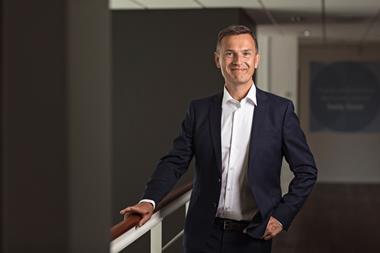
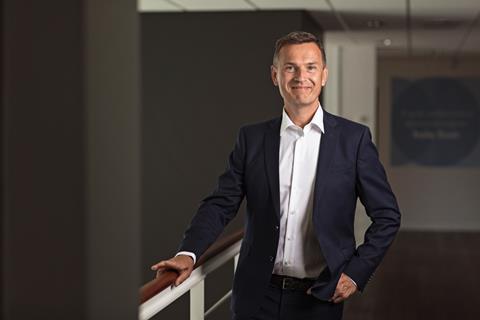
Having now nearly completed the shift to the new strategy, AkademikerPension chief investment officer Anders Schelde told IPE in an interview this week that, separately, the pension fund has just cranked up its portfolio risk, taking it to a level above the average Danish pension fund – from below that average at the end of last week.
According to the Danish official standard for pension fund portfolio risk – a standard deviation-based risk measure – AlfaPension’s risk level for 45-year-old scheme members now stands at 4.1, up from 3.6 on a scale from 1 to 5.
This puts the pension fund on a par risk-wise with peers for the under-45s, but somewhat above them for members above that age, which Schelde said had a significant effect on the terminal value of savings given the higher level of accumulated assets at that age level, he said.
The rationale for levering up came down to the characteristics of the pension fund’s members, the CIO added.
“They earn more than the average person in Denmark, they work longer, they live longer, they have more annuities, so when you put all that together – and we also have a mechanism to smooth returns when they are in retirement - it means we can take a more investment risk than the average fund,” Schelde said.
“Taking just the right amount of risk is a complex matter, because the simple thing would be to invest more in equities across the board and going up to 100% in equities for young people for instance, but we felt that would provide too little diversification,” he continued, citing the famous remark from Nobel laureate Harry Markowitz that diversification is the only free lunch in financial markets.
“Even if you’re young, we felt it made sense to have some credit, some fixed income, some alternatives,” Schelde said.
“Even if you’re young, we felt it made sense to have some credit, some fixed income, some alternatives”
Anders Schelde, AkademikerPension’s CIO
With this challenge in mind, he said his team started looking for a solution where the diversification could be retained while increasing the overall investment risk.
“Last year we’ve been working on designing that, and we’ve ended up with a solution we think is quite good - and not to my knowledge used by any of our peers.
“What we do is we take the fixed income part and we repo it out – we take basically a loan – and the funds we get for that we invest across all our listed exposures, so it’s high yield, investment grade, and equities and emerging market debt and even a little bit of extra AAA exposure. We lever up on all risk components, not just equities,” he said.
Schelde acknowledged that gearing up had a “risky ring to it”, but said the way AkademikerPension had done it was less risky.
“If we’d just thrown out the fixed income and credit exposure and bought equities, we would be much less diversified and in a more risky position,” he said.
“For a long-term investor like us, it’s not a problem to run a small short position like this – we’re not talking anything major, we’re talking 15% of the market value, so I think it’s quite controlled,” Schelde noted.
When taking on gearing, pension funds had to consider potential scenarios where the market might go against them and they had to close their exposure, he said.
“So of course we’ve analysed that quite far, looking back at historical crises and so on, one did some stochastic modelling of the future and so on – and it’s not going to be a problem for us,” the CIO explained.
“Also, because at the end of the day we don’t need to roll anything. We’re not doing this through complex derivatives where markets may freeze up and leave you unable to roll a stressed position,” he said, adding that the repo loan was essentially the only new element to the solution.
“And we already use repos quite a bit in our daily management, so it’s just a little bit of extra repo activity,” Schelde commented.
From an ESG perspective, the repo solution also suited AkademikerPension well, he said.
“Had we instead used derivatives to lever up the investment risk, we would have been exposed to a lot of names on our exclusion list.”