




Norway’s finance minister Jens Stoltenberg has defended the current investment strategy of the country’s huge sovereign wealth fund (SWF), after the Government Pension Fund Global (GPFG), hit by whipsawing financial markets this week, has now lost billions since the start of the year.
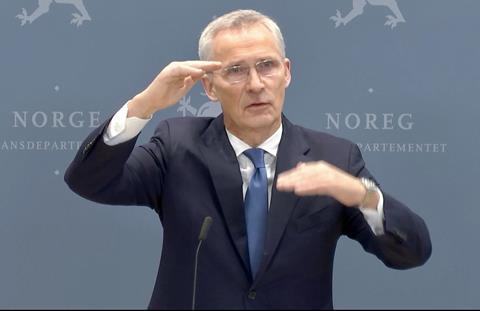
Presenting the government’s annual white paper on the SWF, which comprises the internationally-invested GPFG and the smaller domestic and Nordic investment fund the Government Pension Fund Norway (GPFN), Stoltenberg said: “In 2024, the value of the pension fund increased significantly. However, in recent weeks, we have seen how the value can fluctuate significantly in a short period.”
High uncertainty about tariffs has led to substantial turmoil in international financial markets, he said, adding that since the turn of the year, the value of the GPFG had decreased by approximately NOK1.1trn (€91.2bn).
“We have a long-term investment strategy that enjoys broad support, and we remain calm in the face of turbulent times,” the Labour Party politician said.
“Sudden changes in strategy or hasty decisions must be avoided. In more unpredictable times, broad risk diversification remains the best approach,” said Stoltenberg.
In the report, the ministry confirmed that, as advised last year by manager Norges Bank Investment Management (NBIM), it had decided to remove small emerging market companies from the GPFG’s equity benchmark index, reducing the number of companies in the index by around 22%.
“Sudden changes in strategy or hasty decisions must be avoided”
Jens Stoltenberg, Norway’s finance minister
This was to maintain the intention behind its 2021 decision to cut the number of companies, partly to reduce management complexity, the ministry said. Since then, it said, the tally of firms had risen because index provider FTSE Russell had included more in the index behind the GPFG’s benchmark – particularly from emerging markets.
The finance ministry also confirmed it would start annual withdrawals from the GPFN of 3% of the fund’s value for the first time, in line with practice for the GPFG.
Geopolitics and responsible investment
In the report, it warned that the GPFG’s responsible investment work could be affected by the world’s new, more divided geopolitical reality.
“Geopolitical developments may also weaken the scope of responsible investment activities,” it said, adding: “Developments that challenge democracy, transparency and a free press may make it more challenging to deliver on responsible investment expectations and ambitions.”
A high profile regarding responsible investment entailed a risk that the fund might be perceived as a Norwegian foreign policy tool, it noted.
“Transparency and clear communication of what the fund is, and what it is not, will therefore continue to be important to support its financial purpose and legitimacy,” the ministry said.
On Monday, IPE reported that NBIM appears to have backed away from filing shareholder resolutions – a strategy it launched in 2022.
Read the digital edition of IPE’s latest magazine