




Financial supervisors continue to be wary about the risks posed by the fast growth of private credit issuance in Europe. According to the European Insurance and Occupational Pensions Authority (EIOPA), it’s important to improve the transparency of the asset class.
Today, the biggest threats to financial stability are in the combination of record-high public debt and the rapid expansion of the private credit sector, said Klaas Knot, speaking at the annual EIOPA conference in Frankfurt last Thursday.
“If we factor in demographic pressure, the green transition and increased defence spending, debt could climb to 170% of GDP by 2070. NBFIs (non-bank financial institutions) stepped in to fill the financing gap, and are the new backbone of sovereign financing,” the former president of the Dutch central bank DNB added.
“There has been an increase in the weight of non-bank finance in the European economy,” acknowledged Dimitris Zafeiris, head of the Risks and Financial Stability Department at EIOPA, speaking at the same conference.
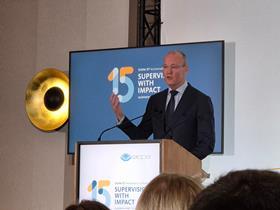
When it published its Financial Stability Report in December, EIOPA warned about the growing risks of private credit to financial stability. Zafeiris noted, however, that it’s important to distinguish between the different providers of private credit when assessing the risks.
He called the term non-bank financial institutions (NBFIs), which is often used to describe providers of private credit, an “oversimplification”.
‘Inherently opaque’
“There are many things that are not banks. I could describe a cat as a non-dog, but if I do that, it doesn’t tell you much about what it is that I mean,” said Zafeiris.
“We know that there is liquidity risk and credit risk piling up in the system, but it’s important that we know where these risks are materialising,” Zafeiris noted.

It does seem to make a difference whether this is happening at an insurance firm or pension fund that has a large capital base, uses little or no leverage and is not at risk of immediate withdrawals by customers or by a hedge fund.
Private credit is indeed “inherently opaque”, noted Knot, adding: “These are private deals with limited disclosure. We need better data to validate this risk as now we don’t know who holds what and who is funding it.”
He concluded with an ominous warning: “The private credit market is still untested. It’s a fair weather asset class that has not gone through a full credit cycle.”
Bernardino: Auto-enrolment can make Europe great again
Participating in a panel at the EIOPA conference, the organisation’s former chair (until 2021), Gabriel Bernardino, currently head of the Portuguese Insurance and Pension Funds Supervisory Authority, took to the stage to champion the introduction of auto-enrolment for second pillar pensions.
“We’re living in times of rupture, in which we need to be bold. In this light, I’m happy with the recommendations from the European Commission on the pensions package. Because they are bold,” said Bernardino, mentioning in this light the Commission’s recommendation to member states to introduce auto-enrolment.
“I hope member states will also be bold in delivering auto-enrolment. This would help to “make Europe great again” as it would unlock financing for investments in the European economy and improve pensions for younger generations, according to Bernardino.
As part of its IORP reform proposal currently under discussion, the European Commission recommends that member states implement auto-enrolment in a supplementary pension product for all workers, with the freedom for individuals to opt out.
Auto-enrolment has recently gained traction in various EU member states. Ireland started an auto-enrolment system for pension accruals on 1 January this year, while Italy is set to follow on 1 July.
In 2019, Poland also introduced an auto-enrolment system. With limited success, as the majority of the country’s labour force remained without a second pillar pension in 2025.