



The Pensions Regulator (TPR) has urged pension trustees to determine the long-term future of defined benefit (DB) schemes and prepare for new requirements on value for money and retirement income in defined contribution (DC) schemes.
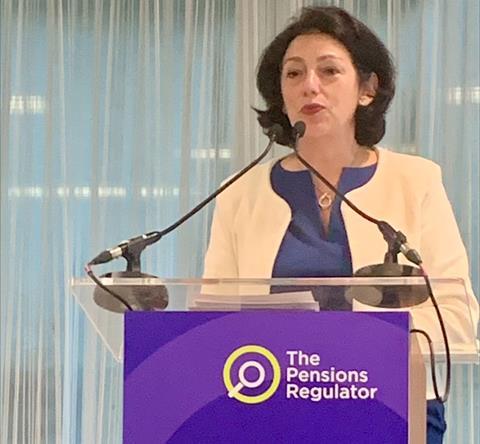
Speaking at an industry event, TPR chief executive officer Nausicaa Delfas said the regulator wanted to see fewer, larger, well-run pension funds delivering security and value in a pensions system geared towards providing a sustainable income in retirement.
To achieve this, she urged trustees to make decisions that will “deliver that sustainable income in retirement for millions.”
For DB schemes, this means taking decisions now on their long-term endgame.
Delfas pointed out that 80% of schemes were in surplus on a low-dependency basis, with an estimated £170bn of surplus assets.
She said trustees should, at a minimum, set a long-term objective, consider all available options and assess whether their current governance structure remained fit for purpose.
“For many trustees, that means making sure you fully understand the new options available.
“For some, it will mean seeking training from advisers. And advisers will need to make sure they understand a wider range of options so that you have enough information to make well-informed decisions.”
Whatever trustees decide, their deliberations on covenant and security, funding levels, governance, costs, investment strategy and other relevant factors must be documented, she noted.
Delfas also urged DB trustees to consider whether and how surplus should feature in their plans.
The surplus regulations are expected to come into force next April, with TPR expected to consult on guidance covering the factors trustees should consider when assessing the release of DB surplus.
DC schemes
For DC schemes, Delfas said trustees needed to determine whether their pension funds could meet the “complex but necessary” new requirements under the Pension Schemes Act 2026.
She said pension schemes had fiduciary obligations and that delivering value for members was important to fulfilling those obligations.
The Value for Money (VfM) framework would encourage schemes to focus on holistic value rather than costs alone, she added.
“If the VfM framework leads to a 1% improvement in investment returns for the average member who started saving at 22, it could lead to a 30% bigger pot by retirement,” Delfas said.
She urged trustees to start preparing by getting their data in order ahead of the March 2028 deadline for submitting data from 2027.
Trustees should also review their investment strategies to ensure they were forward-looking and delivered appropriate returns for members.
Delfas also called on trustees to prepare for new requirements on default pensions and guided retirement.
“If the VfM framework leads to a 1% improvement in investment returns for the average member who started saving at 22, it could lead to a 30% bigger pot by retirement”
Nausicaa Delfas, TRP’s CEO
“Guided retirement requires trustees to design default pensions based on the needs of their members. This means that you are responsible for designing the default pensions, your cohorts of members, and allocating the members to default pensions appropriately,” she explained.
She noted that the number of options was “relatively limited”, highlighting annuities, drawdown and retirement collective defined contribution (CDC) as potential options.
“What is important is that you choose what is right for your members,” she said.
TPR will consult with the Department for Work and Pensions (DWP) and the Financial Conduct Authority (FCA) on developing a framework to “help” trustees with secondary legislation and regulatory guidance.
Delfas said the regulator was committed to “being open” and welcomed early engagement on new ideas or emerging issues.
“Where you spot burden which doesn’t prevent harm – tell us, we’re listening. We also encourage those with new ideas to engage with us early via our innovation service.”