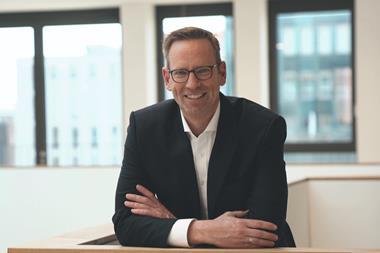
Compenswiss, the organisation managing the Swiss first pillar social security funds – AHV, EO and IV – has restructured its asset allocation to adapt to the materially changed outlook for the funds. Frank Juliano, chief investment strategist, tells DACH correspondent Luigi Serenelli all about it.
For the first time, the Swiss first pillar social security funds AHV, EO and IV are set to have different risk budgets and asset allocations as health and demographic shifts impact the schemes’ outlooks.
The three funds were established after the Second World War: the Old-Age and Survivors’ Insurance Scheme, AHV, in 1947; the Income Compensation Scheme, EO, in 1953, and IV – the Disability Insurance system – in 1960.
“For us, this year is a real game changer,” says Frank Juliano, chief investment strategist of Compenswiss, the brand name for the Swiss Federal Social Security Funds, which manages the funds.
Until now, Compenswiss has relied on one single so-called market portfolio. The social security funds differed only for the amounts of cash allocated to each of them. The risk budgets were differentiated on the basis of the mix of the market portfolio and cash, or treasury portfolio.
For example, Juliano explains, lowering the risk budget for the disability insurance fund IV, which happened about a decade ago, meant increasing cash and decreasing the market portfolio. At the other end, for the old-age insurance fund AHV, the amount of cash decreased to achieve the targeted risk budget. This approach worked as long as the outlooks of the three funds were broadly similar.
However, the outlook of the IV fund is significantly deteriorating. According to figures from the Federal Social Insurance Office (FSIO), the fund will record an annual deficit of around €300m over the next few years.
“For invalidity insurance, the forecasts have been deteriorating steadily over the past two to three years for several reasons, most notably the increasing number of disability pensions granted to young people,” Juliano explains. Although a return to pre-COVID patterns had been expected, this normalisation has not materialised. As a result, we really had to lower the risk budget.”
Two asset allocation strategies
With diverging outlooks, Compenswiss has proceeded to draft two asset allocation strategies, one for AHV and EO, and the other for the IV fund. AHV and EO currently share the same risk budget and EO is performing well, with the forecast improving in terms of insurance – rather than financial – results, Juliano says.
However, AHV will dip into deficit from this year, during the first payout of the 13th month of pension, which is scheduled in December. The public voted in favour of one additional month of pension per year – passed as 13. AHV-Rente – in March 2024.
This is likely to see AHV’s deficit grow to approximately CHF4.2bn (€4.55bn) in 2035, according to the Federal Social Insurance Office, which oversees the nation’s social security system. As such, lawmakers are trying to find ways to put the fund on a sustainable financial footing for at least the next two decades, linking retirement age for women and men to life expectancy, and increasing VAT to fund pensions, following a reform that came into effect in 2024.
A further reform, AHV 2030 – designed to ensure the fund’s financial stability between 2030 and 2040 – is also on the table, while the social security and health committee of the Council of States, the upper house of the Swiss parliament, is proposing to finance the 13th month of pension by increasing VAT and contributions.
“With AHV, we continue to apply the same risk budget as the IV fund, but we have set funds aside starting last year and, since 2025 was the last year with positive insurance results, we decided not to invest the amount, but to reserve CHF2bn to cover the deficit in 2026 – and partly in 2027 – should parliament not approve the financing of the 13th pension,” says Juliano.
Compenswiss
- Manages the Swiss social security funds – AHV (pensions), EO (income compensation) and IV (disability)
- AUM: CHF45.9bn (€49.4bn) as of end 2025
- Will be implementing two new risk budgets and asset allocations – one for AHV and EO, and one for IV, respectively – due to the changing outlook for the funds
- Manages 50% of assets internally and 50% externally
- External mandates: CHF15.4bn actively managed (including high yield, senior loans, private debt, mortgage-backed securities and small-caps equities) and CHF10bn index-based (US large caps and US IG credit)
- Location: Geneva
A downward adjustment of the risk budget may become unavoidable at some point, if the public rejects an increase of the VAT to finance the 13th month of pension. VAT increases in Switzerland must be passed by the public as part of the country’s referendum system.
Under the new strategy, AHV and EO will now allocate 29% of their assets to equities, which continue to represent the bulk of the risk budget. Exposure to foreign fixed income has been cut from 37% to 36% in both funds, while allocations to gold rose one percentage point from 3%.
The equity allocation in IV has been lowered from 29% to 25%, to slightly increase Swiss and foreign fixed income and gold from 3% to 5%. So far this year, IV is performing better due to the adjusted allocation, while the strong overall performance of the three social security funds last year is mainly the result of rising equities and gold “as we let the momentum play [out]”, Juliano notes.
The asset allocations of the funds may continue to diverge in the future, if it is deemed necessary. From an operational standpoint, Juliano says, maintaining different asset allocations only makes sense if they differ substantially.
“We remain in a landscape of known unknowns. We continue to adhere to our strategic asset allocation, avoiding excessive tactical moves, while closely monitoring developments”
Rising private debt allocation
Each year, Compenswiss will reassess the portfolios to determine whether different allocations are necessary, after abandoning a five-year asset allocation plan as a result of changing forecasts driven by demographic trends, funding conditions and political decisions.
Assets in the social security funds are managed 50% internally and 50% externally. Internally, Compenswiss manages less complex strategies closer to the domestic market, such as Swiss fixed income and equities, foreign government bonds and European credit – the latter through active, investment-grade management.
The internal portfolio management team includes fixed income specialists and equity portfolio managers with additional support.
Externally, Compenswiss manages passive mandates such as US large caps that have very low fees and no operational risk, and US investment-grade credit, as the independent public law institution finds accessing the primary market challenging.
More complex strategies – high yield, senior loans, private debt, mortgage-backed securities and small-caps equities – are also managed externally. “As far as external manager selection is concerned, we are three people in charge, including myself. We also rely on internal portfolio managers and our portfolio construction team when necessary,” explains Juliano.
Despite constrictions on the liability side impacting both risk appetite and the ability to invest in private assets, allocation to private debt has increased.
Compenswiss launched the first Requests for Proposals (RFPs) in 2023 and implemented them in 2024. It then launched a second round of RFPs, onboarding nine new managers in 2025.
“Now we have a full private credit allocation currently being called,” says Juliano. Private credit allocations are conducted more through AHV and EO than the IV fund.
“Another reason for differentiated asset allocation is liquidity: IV has a lower capacity to invest in illiquid assets compared to the other two funds,” he continues. “We therefore did not increase private debt for IV, but did so for AHV and EO.”
The target allocation for private debt increased to 3.5% – from 3% – for both AHV and EO, while it remained at 3% for IV. “Once the portfolio is fully called, we may end up at around 4%,” Juliano adds.
Compenswiss is monitoring the software sector within its private credit allocation. According to Juliano, managers tend to lend to companies that are not too cyclical or capital-intensive, and that have predictable cash flows. The risk is ending up with a limited number of sectors, one being software.
“We invest only in senior secured direct lending. There is sector concentration in private debt, which we keep an eye on; and managers have become cautious about the sector,” says Juliano.
The war in Iran
Setting aside discussing investment strategy, the conversation pivots to geopolitics. At the time of IPE’s interview in March, the war in Iran had just entered its first week with the conflict affecting countries across the Middle East.
“We remain in a landscape of known unknowns. We continue to adhere to our strategic asset allocation, avoiding excessive tactical moves, while closely monitoring developments”, Juliano says, responding to a question on what the future holds.
The current situation raises questions about US policy and the future trajectory of the dollar. These longer-term considerations, together with the evolution of the conflict, could influence the medium-term asset allocation of Compenswiss as well as expected returns, Juliano points out.
Inflation remains contained for now, but upward pressures could re-emerge as a result of energy prices increases. “A sustained rise in inflation expectations cannot be excluded,” he says. “Should such pressures persist, the risk of a shift toward a more stagflationary environment – with weaker growth – would pose a significant challenge.”
Last year, Compenswiss conducted a review of its US exposure. A large share of its assets is denominated in US dollars. “We saw the US dollar weakening,” adds Juliano. “Our hedging policy worked well, but the cost of hedging is high – around 4% – so we assessed whether to reduce our gross exposure to US dollars.”
On the fixed income side, the US dollar exposure is aligned with the benchmarks. “We nevertheless added an additional constraint on US Treasuries for 2026, reducing the allocation by 1%, as Bunds hedged to Swiss francs fulfil almost the same role from a portfolio construction perspective,” Juliano continues.
Well positioned
Following the review, Compenswiss considers itself now well positioned, with lower allocations to US dollar-denominated assets than market indices, mainly thanks to the share of investment in equities.
The weight of the US in portfolio is lower than the MSCI All Country World Index (ACWI).
Compenswiss holds fewer US equities and more Swiss and emerging-market equities, pursuing an approach not based purely on market cap that paid off last year. Exposures to US equities are based also on capital market assumptions. Based on these assumptions, US growth is still attractive, but valuations are high, so expected returns from the equity side are lower than consensus.
“When we come to optimisation, we end up with 40% US equities because of valuation and concentration considerations,” says Juliano. “This is embedded in our investment process.”
Assets not invested in the US are rerouted towards emerging markets as well as to Swiss equities. “Switzerland is, first, our home market – we have a bit of home bias. Secondly, we invest in Swiss equities for their defensive characteristics. Thirdly, we try to maximise Swiss-denominated assets to avoid hedging.
“There are not many ways to do that because Swiss fixed income is not very liquid, nor is Swiss real estate,” he continues. “We can, however, expand equities; therefore, we have a bit more Swiss and emerging market equities compared with the MSCI ACWI, and less in the US.”
With its foreign exchange overlay policy, the pension institution looks at the overall portfolio to choose net exposures to each currency, ending up with explicit FX exposures, a somewhat different approach from other pension funds.
“We consider all our mandates fully hedged in Swiss franc and a vector of currencies, in order to decide how much dollar or euro exposure we want. This results in hedge ratios that vary by currency, roughly between 50% and 90%,” Juliano explains.
The US dollar is approximately 75% hedged. Compenswiss strongly believes that partial hedging brings diversification and benefits to the portfolio, while full hedging is costly.
“It is beneficial to keep some USD exposure for diversification purposes, even though we somewhat suffered last year for the proportion of unhedged dollar investments,” he says.