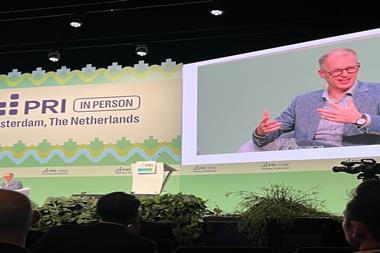









Morten Rask Nymark, head of equities at Industriens Pension, explains why the Danish pension fund finds it important to mantain a diversified exposure to private equity alongside its listed equity investments
Industriens Pension
- Type of pension fund: Danish labour-market pension fund
- Members: 449,000
- Total assets, end 2025: DKK 279bn (€37bn)
- Listed investments: 68% of total portfolio
- Unlisted investments: 32% of total portfolio (private equity, infrastructure, real estate, private debt)
As a long-term investor, we believe both listed and private equity have an important role in building a robust equity portfolio with an attractive risk-return composition. Listed equities provide daily liquidity, transparency and broad, low-cost exposure to global companies, while private equity can provide access to companies and growth opportunities that aren’t available in public markets.
In the small and mid-cap market particularly, we have found attractive return drivers from professionalising small companies’ organisations and operations in a way and to a degree that’s often difficult to find in the public market.
We achieve this through a combination of global listed-equity mandates - both active and passive mandates – and investments in carefully selected private-equity funds, alongside co-investments where appropriate. The private portfolio is diversified across managers, vintages, sectors and regions.
It is becoming more important to have private equity in the portfolio these days, for several reasons.
One is that the public market, in the form of global indices such as the MSCI ACWI, has become very concentrated geographically, sector-wise and theme-wise. And with only a very small percentage of the world’s companies being listed, you get a broader and more diverse equity portfolio by adding the private market to your investment universe.
We often see that new innovations and technologies tend to come out of smaller companies in the private market – rather than from large public companies.
We do have a broadly diversified portfolio in unlisted equity, but of course a large portion consists of the US and European markets within the IT, industrials and healthcare sectors.
Private markets have also become more relevant because an increasing proportion of companies remain private for longer – so some growth opportunities aren’t captured by listed markets.
In today’s world, we see that the private market – at least in some markets – is well established in providing funding for scaling businesses into very large entities, with SpaceX, OpenAI, Anthropic being the best examples.

The main challenges when it comes to investing in private equity include illiquidity, higher fees and costs, manager stickiness – especially when quality issues arise – limited transparency compared with listed markets, more resource-heavy internal workflows and workloads, and longer investment horizons.
At Industriens Pension, we address these challenges through manager and investment due diligence, diversification across funds and vintages, careful liquidity planning, strong legal and ESG processes, ongoing monitoring and the use of the secondary market. We also assess private investments against their total cost, expected net returns, returns compared to risk and illiquidity factors and alternative placement of the capital.
Different pension funds do have different approaches to private equity, because they might have different risk appetites and return objectives, liquidity requirements, member demographics, regulatory and accounting conditions, internal investment capabilities and exposure to other illiquid assets. There is no single “correct” allocation to private equity.
It is true that due diligence on private equity investments is both expensive and resource-intensive. That’s an important consideration, but not in itself an argument for replacing private equity with listed equity. The question one needs to ask is whether the expected net return and diversification benefit justify the additional cost, complexity and illiquidity.
Scale is helpful – it allows us to build specialist expertise, negotiate terms, access high-quality managers and invest through co-investments.
However, listed equity remains essential for us, because it offers liquidity, transparency and very low-cost exposure.
Looking ahead, our aim at Industriens Pension is to maintain a well-diversified portfolio combining public and private investments. We expect private equity to remain an important component, but future allocations will depend on our strategic asset allocation, i.e. valuations, expected net returns, liquidity, risk and the overall composition of the total portfolio.