





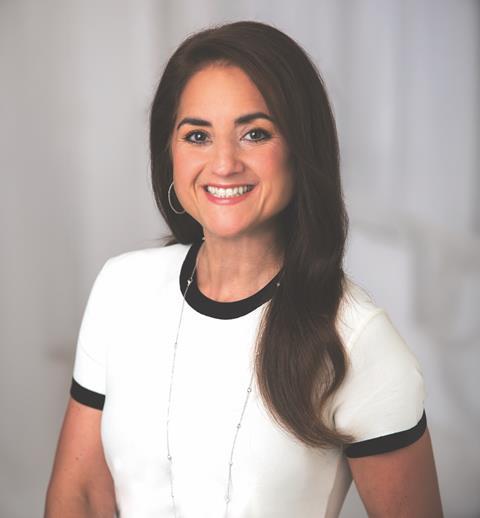
Kate El-Hillow, president and CIO of Russell Investments, tells Carlo Svaluto Moreolo about competing in fiduciary management, private markets and total portfolio allocation
- Russell Investments is one of the largest global players in fiduciary management
- Kate El-Hillow, president and CIO, points to the firm’s flexible, open architecture model
- The firm seeks to expand its footprint in private markets and the retail segment
Considering the benefits of fiduciary management, and of its ‘lighter’ version – the outsourced chief investment officer (OCIO) – for institutional investors of all kinds, it is hard to tell exactly why this model has not gained a greater share of the market.
Perhaps it has to do with the two must-haves of successful fiduciary managers – scale and flexibility. Only the firms that are serious about this model will put in the resources to secure both.
Russell Investments is among those selected few. It is ranked as the fourth-largest OCIO provider globally, with well over €800bn of assets under advice (AUA) and almost €330bn of assets under management (AUM) as of last year. A good measure of its scale is the $2trn worth of assets that it trades annually on behalf of its clients.
Russell’s core business is fiduciary management and customised portfolio solutions, which includes transition management, overlay strategies and enhanced portfolio implementation, a form of multi-strategy segregated account management. But the firm also offers a range of equity, bond, multi-asset and alternative funds as well as private markets and unlisted infrastructure strategies.
Kate El-Hillow, president and CIO of Russell Investments since 2022, says the firm’s success as a fiduciary manager is down to its “fully open architecture, meaning we can invest in all the asset managers around the world”, but also to its “implementation capabilities” that allow the firm to construct portfolios and risk-manage them “in a really integrated way”.
Russell Investments started out as a stockbrokerage and consulting firm in 1936 in Tacoma, Washington. Its founder, Frank Russell, later created the well-known US small cap index, the Russell 2000, and in the late 1960s, the firm landed its first fiduciary client, the corporate pension fund of JCPenney, the American department store.
The Russell family retained ownership until the late 1990s, when Northwestern Mutual, a US financial institution, acquired the group. Later, in 2014, the London Stock Exchange Group (LSEG) bought the firm and carved out the index business, which was later rebranded FTSE Russell. Shortly after, the advisory and investment management business was acquired by private equity firm TA Associates, which retains control today.
At a global level, three-quarters of Russell’s clients are institutions, and half of them are based in the US. However, the firm has a longstanding presence in Europe, especially the UK and the Netherlands, and in Asia Pacific, with offices in Tokyo and Sydney.
The firm’s UK headquarters are in London’s Regent Street, where IPE met El-Hillow in late January, during one of her frequent visits to Europe.
El-Hillow joined Russell in 2021 as global CIO, after a career largely spent managing multi-asset investment solutions, first at JP Morgan, and then at Goldman Sachs, where she was most recently deputy CIO of multi-asset solutions. Today, El-Hillow splits her time across investment management, client-facing activities and strategy in roughly equal measure.
Russell Investments key facts

Kate El-Hillow at last year’s Russell Investments Global Town Hall in Seattle
$377bn
Total AUM of Russell Investments
$962bn
Assets under advisory
31
Number of countries where Russell Investments’ clients are located
“I would not want to give up any of those tasks, which is why I feel like I’m in a pretty lucky position,” she says. “I love working with clients on solving their problems and creating portfolios for them.”
A “full suite of asset management implementation services” underpins all Russell Investment’s activities, which is why its core business is, and will continue to be, fiduciary management and OCIO. These models are fairly popular in certain countries and contexts, namely the UK and the Netherlands. But they have had ups and downs, and relative to their potential market share, they are perhaps falling short.
In the UK, especially, fiduciary management assets have reached a plateau, and the number of full fiduciary managers has shrunk. This, in one sense, lowers the bar in terms of competition. In reality, UK pension schemes are increasingly choosing to outsource part of the boring but incredibly important tasks – such as selecting managers and implementing an asset allocation strategy – to external teams, while they focus on the important stuff, ie designing the strategy itself.
This is a time for veteran firms like Russell to shine.
“I have been in OCIO and solutions for 25 years, and I’ve seen lots of providers coming out of the woodwork,” says El-Hillow. “But it takes a lot of investment and infrastructure to do OCIO and fiduciary management in a rigorous way. That’s why we have seen some of the consolidation.”
Public-private integration
Still, the challenge for Russell is to continue developing its intellectual property and to continue to invest in technology and data, according to El-Hillow. One key goal is to further build expertise and capacity in private markets, given the role that this broad asset class plays in both institutional and private portfolios.
El-Hillow points to Russell’s track record in this area, dating back five decades, when the firm started investing in real estate on behalf of its clients. Then came private equity, and, more recently – about a decade ago – a private credit operation was launched.
Under the leadership of El-Hillow and chairman and CEO Zach Buchwald, former head of institutional business at BlackRock, Russell is now trying to stay ahead of the curve in private markets.
El-Hillow says: “In the past couple of years, we have started to merge our public and private teams together, both on the research side and on the portfolio management side. It comes naturally, because we are more focused on the multi-manager business versus originating the deals, but it really makes a lot of sense when you think about how you build a portfolio. You don’t want things in silos. In areas like credit, the differences between public and private are much less than the similarities.”
It started with bringing senior fixed-income portfolio-management staff over to the private side, says El-Hillow, and what follows is a holistic approach to managing credit portfolios across the public/private spectrum, whether it is to diversify and take advantage of opportunities, or to manage liquidity needs.
“If you add the advancements in data and technology, and the challenges around transparency and pricing of private market assets, this integration between public and private is really going to change how investors construct and manage portfolios in the coming decades,” she adds.
Fresh take on TPA
Holistic portfolio management is synonymous with total portfolio approach (TPA), a term that has been appearing more often in discussions about institutional portfolio management, at least since last summer, when US pension giant CalPERS said it would switch to TPA from strategic asset allocation this year. Some contend that TPA is just an old trick with a new name, but El-Hillow gives more credit to this discussion. “If some of the largest and most sophisticated asset owners are thinking that this is a different approach to what they have been doing in the past, we should try and understand,” she says.
“You want to have the people who understand the bottom up talking to the people who understand the top down really well”
What is new, according to El-Hillow, is that investors are trying to break the walls between portfolio management teams, much like Russell is doing. “You want to have the people who understand the bottom up talking to the people who understand the top down really well,” she says.
The other key reason why TPA has assumed new relevance today is the nature of market and business cycles, combined with noise and volatility.
“With market cycles that seem to be shortening, the attraction to TPA is that it gives the ability to think more dynamically about portfolio exposures,” El-Hillow says.
This is not about making tactical asset allocation decisions; it’s about positioning portfolios appropriately around the changes in market regimes, aided by the broader sets of data that are available to analyse portfolios today, she adds.
Russell’s strategic goals, as described by the CIO, fit well within this landscape. El-Hillow says the firm wants to leverage its “open architecture, custom implementation” model to continue to expand the client base among different types of institutional investors, and to help clients navigate changing market scenarios more dynamically.
Empowering the individual investor, especially in the retail space, is an equally important goal, given the greater role that retail investors are gradually assuming in markets. “They need the same type of risk tools and ways of thinking about how to manage their money as institutional investors, and we can provide those at scale and in a customised way. It’s a huge opportunity for us,” El-Hillow says.
Kate El-Hillow is president and CIO at Russell Investments. She joined in 2021 from Goldman Sachs Asset Management where she served as deputy CIO of multi-asset solutions. Previously, she spent eight years at JP Morgan Chase, where she held roles including client portfolio manager and chief operating officer.










.jpg)