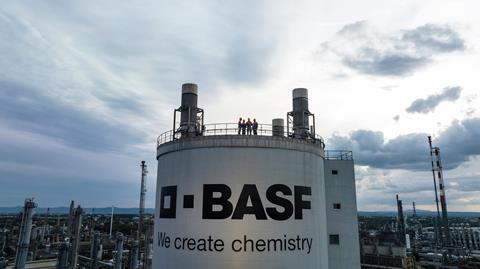
Investors representing over $1.25trn in assets under management plan to challenge BASF at its annual general meeting (AGM) on 30 April over the alignment of climate lobbying with net zero ambitions.
The group will call on the German chemical group to align its policy engagement with its net-zero 2050 commitment, amid concerns it has sought to weaken key elements of EU climate regulation.
BASF, the world’s largest chemical company, has been accused by campaigners of lobbying against EU carbon pricing rules, including the EU Emissions Trading System (EU ETS) and the Carbon Border Adjustment Mechanism (CBAM).
While BASF supports the EU ETS, investor groups argue its lobbying has pushed to delay and dilute reforms central to the system’s effectiveness.
ShareAction’s Jackie Garton said: “Excess free allocations under the EU ETS have created a structural incentive to maintain the highly polluting status quo in chemical production. BASF has received far more allowances than it actually needed, profiting from the surplus while European governments forfeited those revenues that could fund decarbonisation.
“BASF is now lobbying to weaken the very regulations designed to phase these allowances out. This will reward companies slow to invest in the energy transition while penalising those who have already committed to a net-zero future. More than 100 businesses – including Heidelberg Materials, Tata Steel, and Volvo – have rightly made clear that undermining the ETS serves neither energy security, competitiveness nor decarbonisation.”
BASF has opposed the phase-out of free ETS allowances, called for the exclusion of organic chemicals from CBAM, and in media interviews, its chief executive officer has called the ETS “obsolete”.
The company wields influence over EU climate policy through Cefic, where its CEO has served as president since January 2026.
James Crawshaw, head of sustainability and impact at Inyova, said: “As long-term investors, we understand that the EU ETS and CBAM are not a cost to be managed away – they are the market signal that makes decarbonisation investment rational. ETS works not only through the carbon price it sets today, but through the long-term signal it sends to investors and firms planning future capital expenditure – a signal that only works if the system is perceived as robust and permanent.”
Lidia Tamellini, policy officer at Carbon Market Watch, added: “Between 2014 and 2024, BASF emitted almost 127 million tonnes of CO2 that were released in the atmosphere from its plants. Not only have they failed to pay for that CO pollution, but during those 10 years they received 134 million in free allowances: if banked, the excess would currently be valued at €500m.”
EU ETS, launched in 2005, covers about 40% of emissions and is a EU climate policy pillar, while CBAM becomes operational in January 2026 to curb carbon leakage and support carbon pricing.
The EU ETS and CBAM are increasingly seen by investors as central to Europe’s decarbonisation strategy, with the BASF AGM set to test how far companies can reconcile lobbying positions with stated climate commitments.