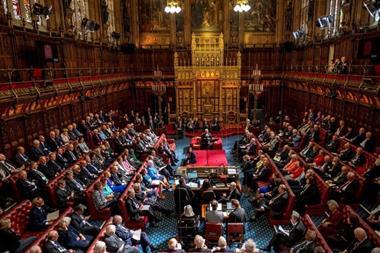

The UK government suffered another defeat last night over proposed powers to compel defined contribution pension schemes to invest in line with its priorities, risking the collapse of the entire bill.
Despite the government watering down the so-called mandation powers in its Pension Schemes Bill and amending the sunset clause, the House of Lords voted 234 to 152 to send it back to the Commons for further discussion.
Last night, the government brought forward the current sunset date for the reserve power from 2035 to 2032, which extends beyond the current Mansion House Accord commitment of reaching its target by 2030. Under the terms of the amended bill, mandation would also be limited to no more than 10% of total assets held in default funds and no greater than 5% in UK-based assets.
However, the House of Lords – in its fourth sitting on the bill – remained unconvinced.
Deborah Stedman-Scott (Baroness Stedman-Scott), a former Conservative parliamentary under-secretary of state for work and pensions, said the government should not be directing any investment of assets held by private funds.

“The power that the government is setting out in the bill directly undermines the principle of fiduciary duty on which the entire pensions system relies. It must, by now, be plainly obvious to the government and the minister that any investment that has to be forced by the government is not in the interest of savers,” she said.
Pensions minister Torsten Bell said yesterday: “Let me be clear that the House today is being asked to consider a reserve power that is highly constrained and narrowly focused on solving a very specific problem. It is capped at the accord targets and provides for absolute neutrality among private asset classes.
“The government cannot direct investments,” Bell added.
Flawed policy
Conservative shadow work and pensions secretary, Helen Whately, described the move as a “U-turn” and said it amounted to an “admission that the mandation powers are indefensible”.

Former pensions minister and partner at LCP, Steve Webb, said: “Ministers should recognise that there is a reason for the continued and cross-party opposition to their plans, which is that mandation is a fundamentally flawed policy.
“There is so much that is good in the Pension Schemes Bill, it would be wholly unacceptable if the government’s stubbornness – on a power they say they don’t even plan to use – puts the whole bill at risk. It is time ministers stepped back from the brink and instead started listening to the legitimate concerns that are being raised.”