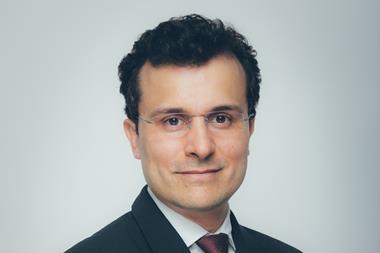
Alessandro Ferretti, Fondo Pegaso’s head of finance, talks to Luigi Serenelli about the creative solutions that the pension fund for Italian utility workers has forged to match its members’ needs
The team at Fondo Pensione Pegaso might be small, but it does not lack creativity when it comes to managing the assets of the pension fund for Italian utility workers.
Headquartered in Rome, the second-pillar pension scheme now has more than €1.6bn under management, and IPE recently caught up with Alessandro Ferretti, the fund’s head of finance, to learn more about Pegaso’s history – and its plans for the future.
Fondo Pegaso at a glance
- Industry-wide DC fund for employees of Italian utilities
- Established: 2000
- Headquartered in Rome
- AUM: €1.62bn
- Members: 40,789
- Employers: 512
Ferretti, dressed casually for the video call with IPE late on a Friday afternoon in a brown hooded sweater, recalls joining Pegaso back in 2012. He was the fourth employee of the pension fund, which had been established in 2000, and he dealt with pension payouts before moving to the financial unit.
The ‘Bilanciato’ was the first sub-fund launched, Ferretti tells IPE, which had 30% equities and 70% in bonds. Over the years, the number of sub-funds has grown to three; simultaneously, the financial offering for members has also widened.
In 2007, Italy passed a law mandating ‘Garantito’ sub-funds, which are majority bond vehicles that guarantee both protection and a minimum income, and that also contributed to changes in the fund’s overall structure, he explains.
Pegaso was founded on the principle of risk control, with mandates delegated to managers to reduce costs. “We have very low fees with customised mandates,” says Ferretti, who completed a master’s degree in supplementary pensions law and economics, run by Mefop, the organisation charged with developing Italy’s pension fund market, and Tuscia University.
Despite the portfolio becoming broader, the organisational structure has remained streamlined. Twenty-five years after it was first launched, Pegaso, a defined contribution pension fund, now has 10 employees, with general manager Andrea Mariani appointed in 2009.
In accordance with IORP II regulations, the fund has a head of risk management and a staff member overseeing internal auditing who is tasked with preparing quarterly reports to submit to the board of directors as well as the auditors.
Assets have grown over time as the average age of members has decreased. Young people in Italy are starting to realise that savings in the pay-as-you-go first pillar are not enough to support their future, and are increasingly opting for supplementary pension plans, Ferretti notes. Along with a fast-ageing population, Italy’s birth rates are now at their lowest level since the country’s foundation in 1861.
In response to demographic changes, Pegaso restructured its financial offering in 2024, closing a sub-fund that had 50% of assets in equities, and creating a new one that invested 70% in equities. The current structure now includes three sub-funds and five investment profiles, combining allocations in the sub-funds.
Unipol won the tender for the ‘Garantito’ sub-fund in 2022, when interest rates were low, and, when they rose in mid-2024, Pegaso decided to extend the mandate with the insurer.
‘Investing in semi-liquid funds’
“This led us to begin discussions with the manager about the possibility of investing in semi-liquid funds, based on their initial proposal,” Ferretti says. Unipol and Prometeia Advisor Sim, Pegaso’s financial adviser, studied the structure of the mandate.
“Unipol believed that the volatility of semi-liquid funds is like that of bonds, meaning low, but returns are robust,” Ferretti explains. “Therefore, adding semi-liquid alternative investment funds (AIFs) won’t impact investments in equities.”
As a result, Unipol selected four semi-liquid funds, two private equity and two infrastructure funds. “Now the sub-fund’s assets are invested 5% in equities; 5% in infrastructure and private equity; and 90% in bonds,” he adds.
Pegaso is already preparing the next step, considering the possibility of including this kind of hybrid mandate in the Crescita sub-fund, which is managed by Eurizon Capital, with 70% of the assets invested in equities. “We would like to include private equity to reduce market volatility and boost returns,” Ferretti says. The Crescita sub-fund was launched in June 2024 with €110m and currently has €200m under management.
The pension fund approached semi-liquid funds through the European Long-Term Investment Fund (ELTIF) market and has invested in private debt via ‘Progetto Zefiro’ (Project Zephyr), the consortium of Italian DC pension funds dedicated to private credit of which Pegaso is a member. This semi-liquid fund was included in the ‘Bilanciato’ sub-fund with an eye to investing in private debt globally.

“In private debt, we have an eye on Europe, but studying the asset class, we have opted for a global mandate, because a focus on Italy meant going for a lower credit rating,” Ferretti explains. “In infrastructure, instead, we considered the global core choice appropriate, investing in large funds, and approximately 40% invested in Italy.”
Pegaso invests in infrastructure through Project Vesta, another consortium launched in 2022 to invest in European infrastructure, focusing especially on energy transition and sustainable assets. “In infrastructure, we invest in the Green Arrow Tages Capital and Ersel funds, which focus on renewable energy in Italy,” says Ferretti. “The focus is on Italy for renewables, while we pursue core-core plus strategies globally.”
Small infrastructure funds target the mid-to-low market segment, while larger ones struggle to attract commitments. “Italian infrastructure has attracted 60-70% since we launched Vesta,” he says. “The global segment, on the other hand, is attracting commitments much more slowly; the larger the projects, the slower the recall.”
Investments in private equity
Europe and Italy are the focus for investments in private equity. Pegaso, as part of the private equity consortium known as ‘Progetto Iride’ (Project Iris), invests in two funds, Renaissance and Aurora, that had formerly been managed by Neuberger Berman before being taken private this year.
“We made a second round of private equity investments in Europe through Project Iris, and in Italy in excellent companies, such as Rino Mastrotto, and SICIT, which exited the Renaissance fund,” Ferretti says. “Choosing a private equity fund is not easy, because there is no visibility on the investment the general partner chooses.”
So far, Pegaso has committed €75m to Iris, €80m to Zephyr and €40m to Vesta. Through the partnerships, the semi-liquid funds’ investments are more diversified, and risks are diluted, he adds.
Private market investments are now playing a larger role in the portfolio since investments started about six years ago.
Pegaso has shifted from investing in Europe to diversifying globally, also thanks to private markets, especially in liquid assets. Equities are invested through two active global equity mandates, accounting for approximately 20% of the assets in the Bilanciato sub-fund, and two balanced mandates accounting for another 6% of total equities.
The benchmark is primarily global, focused on developed countries, with a residual share in emerging markets. In the Crescita sub-fund, the equities are managed through Eurizon’s semi-active balanced mandate with a global benchmark.
In global equities, however, Pegaso has carved out part of the benchmark to create a mandate, dubbed the PMI Italia project, that was granted to asset manager Anima to invest in small and medium-sized companies listed on the Italian stock exchange.
“This will include approximately 30-40 companies with €80m invested,” Ferretti says. “We’re focusing on companies with a market capitalisation between €150m and €2bn, listed on the STAR index, in the lower end of mid-sized companies.”
Anima built a portfolio of companies between September and October, with the benchmark coming into effect on 3 November. In the meantime, Pegaso is also looking at venture capital as part of the mandate of its PMI Italia project.
“We’d like to invest 10% of the mandate in venture capital funds. Pegaso invests through the sub-fund Bilanciato, the largest with €1.2bn of assets, in venture capital,” says Ferretti. Pension funds’ investments in domestic venture capital have helped Italian companies to grow, he adds. “There are many innovative start-ups in Italy, both for equity and infrastructure investments.”
Long-term view
Investments in young tech firms and renewable energy underscore how important the long-term view is for Pegaso. The strategic asset allocation is based on the members joining the pension fund. “By studying some sample profiles, we are able to determine the members’ potential future performance needs, and with these constraints, we build the internal structure of the sub-funds, which includes a plurality of managers,” Ferretti says.
By law, Pegaso is not allowed to take tactical decisions, but it is able to optimise the sub-funds’ internal asset allocation with specialised mandates featuring different strategies, Ferretti says. The pension fund always opts for two “twin mandates” with two different strategies to not always achieve the same results, he adds.
“We have four global aggregate managers in the ‘Bilanciato’ sub-fund, each specialising in a specific area. The same applies to the two global equity mandates: one stock picker and one qualitative manager,” Ferretti continues.
As a long-term investor, short-term market volatility is considered par for the course; Ferretti cites how quickly the markets recovered after the crash during the COVID-19 pandemic with the help of central banks.
“With the returns of 2023, 2024 and 2025, we have largely recovered from the declines of previous years,” he says. “The strategic asset allocation focuses on the long term. We define the guidelines for managers; very risky investments are not included in our portfolio. The mandates last five years, and there is time to recover any losses.”
A look at the macroeconomic situation shows inflation in Europe remaining around the 2% target, and above the target in the US. “I’m concerned [instead] about equities valuations, with most indices at record highs,” Ferretti continues. “With high valuations, fundamentals will become the core for evaluating investments in the future.”
A further cause of concern is the impact of geopolitical and trade imbalances, which could pose a medium-term risk. “However, over the longer term, everything should normalise,” he says. “Financial markets appear to be decoupling from politics.”
The pension fund’s exclusion list includes unconventional weapons and companies with more than 5% of their turnover generated from tobacco, pornography or unconventional oil & gas. The adviser Nummus.Info performs ESG analysis of the fund’s portfolio both in aggregate and for individual mandates.
Pegaso is also involved in two projects with pension funds association Assofondipensione, one on voting rights, with the proxy adviser helping to receive analyses and define guidelines shared with all other pension funds for voting at AGMs. In 2024, the pension fund participated and voted at 98 companies’ annual general meetings.
“We started voting at the AGMs in Europe, and, in the second year, we went to the US, trying to establish partnerships with Italian branches of American companies,” he says. Ferretti argues that it is too simplistic to think there is opposition to ESG in America.
“We know that the coastal areas are as sensitive to the topic as Europe, but Texas is also one of the largest solar energy producers,” he says. “I don’t know how opposed they are to clean energy. I think, more than anything else, the ESG label is annoying [for them].”
Fondo Pegaso’s asset allocation and mandates