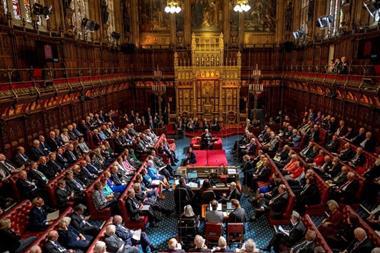





Proposed government powers over pension investment and new restrictions on default schemes have triggered warnings in the House of Lords that risk could be shifted onto lower-income savers, while market consolidation may weaken competition and innovation.
The sixth committee-stage debate on the Pension Schemes Bill focused on Clause 40, covering asset allocation and investment risk in defined contribution (DC) pension funds, and Clause 42, which allows regulations restricting the creation of new non-scale default pension arrangements.
Clause 40 introduces reserve powers enabling the government, under certain conditions, to influence how pension funds allocate assets, including encouraging investment in private markets. Ministers argue that this could improve long-term returns through diversification.
Opposing the clause, Susan Kramer (Baroness Kramer) tabled amendment 167, seeking to protect members of automatic enrolment default schemes if mandated investments underperformed a low-cost benchmark.
She warned that default schemes are “vehicles for those with the narrowest shoulders, with low incomes, small pensions and little financial knowledge”, adding that the downside risk for those savers means “poverty”.
Baroness Kramer argued that if ministers were confident in their policy, a government-backed safety net would be cost-free. She said: “If the government believe their own words, accepting my amendment means taking no risk at all for the government or taxpayer.”
The amendment was supported by William Vaux (Lord Vaux of Harrowden), who asked: “Who should take the risk that arises from the government mandating investment in particular asset types?”
Responding for the government, Maeve Sherlock (Baroness Sherlock), minister of state in the Department for Work and Pensions (DWP), rejected the amendment, arguing that compensating savers would undermine investment discipline and “create moral hazard”.
She added: “Nothing in the Bill disapplies trustees’ existing duties of loyalty, prudence and acting in members’ best interests.”
Following the debate, Baroness Kramer withdrew the amendment.
Consolidation concerns
Peers also debated Clause 42, which enables regulations restricting the creation of new non-scale default arrangements as part of the government’s strategy to consolidate the pensions market.
Sheila Noakes (Baroness Noakes) tabled amendment 168, alongside related amendments, arguing that the clause embeds an anti-competitive approach.
She warned that the Bill risks discouraging new providers, describing the policy as “squashing new entrants into the market”.
Baroness Noakes argued that innovation depends on market entry rather than consolidation, saying: “Healthy markets are those in which innovation can challenge existing market norms.”
John Fuller (Lord Fuller) echoed those concerns, warning that the Bill would entrench large incumbents and weaken competition. He said it would “weaken returns, increase costs, damage competition among funds and weaken the UK economy”.
Defending Clause 42, Baroness Sherlock said the government’s aim was to reduce market fragmentation that delivers poor value to savers, while still allowing innovation where it improves outcomes.
“The government’s objective is clearly to move to a market of fewer, larger providers so that savers can benefit from better governance, greater investment sophistication and lower costs,” she told peers.
“We want innovation, but we want innovation that will serve member interests,” she added.