


All Features articles – Page 20
-
 Features
Briefing: Why gold is different
Why does gold behave so differently from industrial metals and, indeed, most commodities in general? Despite the obvious contrasts – such as its shininess and its use in jewellery – it is not immediately clear why this should be the case.
-
 Features
Long term matters: Commenting from the cheap seats or on the playing field?
Scientifically literate investment executives who care about the future of human civilisation and the ecosystem will be painfully aware that Jean-Claude Juncker’s comment about the euro-zone also relates to the climate crisis.
-
Features
Pensions Insider: Improve your effectiveness by joining the inner circle
In the third of a series of articles aimed at empowering trustees, our insider outlines the importance of patience and networks in complex, illiquid transactions
-
 Features
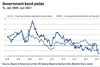
Fixed income, rates, currencies: Market signals cloud the picture
From preliminary data, Europe’s second-quarter growth appears to have been surprisingly strong, seemingly led by services, such as strong retail sales. Supply-side problems are still constraining the goods sector generally, hitting the German economy especially, with industrial production falling more than one percentage point over the second quarter.
-
 Features
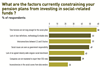
Research: Engagement key to navigate the raft of social complications
Simon Klein and Amin Rajan find investors are opting for more social-related investing
-

-
-
 Features
IPE Quest Expectations Indicator - July 2021
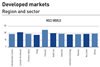
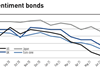
At the time of writing, over half of the US population was vaccinated against COVID-19 with the EU at 40%. UK figures give a positive picture but the threat of new strains remains. The G7 have announced plans to supply vaccines to developing countries.
-
 Features
IPE Quest Expectations Indicator - August 2021
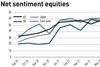
The next wave of COVID-19 has come to pass earlier than expected, largely due to new variants. The UK is hard hit, being sensitive to variants Alpha, Beta and Delta. The EU is next in line, with the Netherlands, Spain and Denmark in the forefront and Delta playing a leading role, but other member states are right behind. There is no sign of the next wave in the US yet, but it is sensitive to the variants Gamma and possibly Alpha, which plays a role in Canada.
-
Features
Accounting: The Friedman conundrum
The world, or rather capitalism, has come a long way since Milton Friedman’s 1970 New York Times opinion piece The Social Responsibility of Business is to Increase Its Profits. Corporations, he argued, have no responsibility beyond the duty they hold to shareholders.
-
 Features
European venture capitalists finally adopting ESG
Many would argue that venture capital (VC), at its core, has a positive impact on the world as it is driven fundamentally by the desire to solve society’s problems. But there is a contradiction between that driving mission, and the reality of the slow adoption of ESG into the consciousness and the investment processes of VCs and their assets.
-
 Features
Digital transformation: Take advantage of the digital reset
Covid has accelerated the digital transformation across all industries. How has it contributed to new trends and opportunities in private debt and how can investors benefit?
-
 Features
Ahead of the curve - Green assets: An alternative to green bonds
Policy performance bonds, in which returns are linked to ESG outcomes, would be a positive alternative to green bonds
-
 Features
Strategically speaking: Lyxor & Amundi
Lyxor has made a mark over the 20-plus years of its existence, pioneering managed accounts for hedge funds, including the first dedicated institutional managed account platform, that it created for PGGM in 2010.
-
Features
Pensions insider: A DIY approach could harm large transactions
In the second in a series of articles aimed at empowering trustees, our expert contributor describes how to diplomatically sidestep problems when your good in-house team isn’t right for a complex task
-
 Features
Briefing: Central bank digital currencies take shape
Central bank digital currencies (CBDCs), also sometimes called govcoins, have suddenly become a subject of public discussion. Until recently the topic was mainly the preserve of a coterie of technical experts working for central banks and niche technology firms. But now there seems to be immense excitement about their potential to transform finance. There are even some who suggest the new technology could allow the renminbi to overtake the dollar as the world’s leading cross-border currency.
-
 Features
Briefing: New benchmark to reduce cost of FX transactions
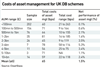
Among the areas of focus for a pension fund looking to cut costs are the fees charged by its asset managers, usually as an annual percentage of assets under management, plus costs for other services. As part of a cost-cutting exercise, however, foreign exchange (FX) is often neglected. But as funds increasingly invest outside their home country, FX transactions are acquiring more significance because of the need to hedge foreign currency fluctuations. And these deals can carry hidden costs.
-
 Features
Briefing: Bonds on the blockchain
Bitcoin’s wild ride has been hard to ignore this past year. However, it has mainly attracted its stalwart audience of retail investors, family offices and hedge funds. Institutional investors mostly sat on the sidelines, although interest has been piqued. Digital assets, most notably bonds and not cryptocurrencies, are likely to garner the inflows owing to the comfort of regulation and established market infrastructure.
-
 Features
Briefing - Growth private equity: From margin to multiple
Private equity may have a reputation for buying cheap, levering up and selling high. But with a record $30bn (€25bn) sitting in European growth vehicles, true business growth is expected to play a greater role in coming years.
-
 Features
Briefing - Energy: IEA sets net-zero target
The energy sector is the source of about three-quarters of greenhouse gas emissions at present and yet until only recently, the influential International Energy Agency (IEA), an inter-governmental group, had not produced a fully-fledged aligned pathway with the goal of limiting the rise in global temperatures to 1.5°C above pre-industrial levels.