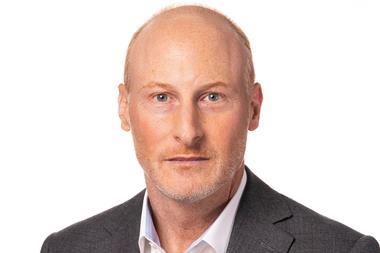





Lazard Asset Management makes a strong case for fundamental research and active management, Europe co-CEO Jeremy Taylor tells Carlo Svaluto Moreolo
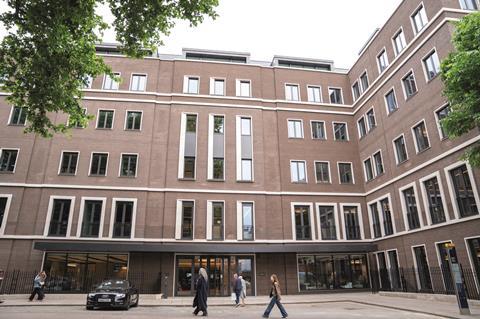
Jeremy Taylor, co-CEO of Lazard Asset Management (LAM) in the UK and Europe, told his employees that the recent relocation of the company’s London headquarters to 20 Manchester Square is going to herald Lazard’s “Beatles moment”.
- Lazard AM focuses on active management, driven by fundamental research
- Assets are split between equities (78%), fixed income (18%) and alternatives (4%)
- Around two-thirds of the assets are held in segregated mandates on behalf of institutions and large third-party distributors
The historic site, located in the heart of Marylebone, had previously been the headquarters of EMI, the legendary UK music industry group. Taylor recounts how shortly after moving there in the early 1960s, EMI signed a then-unknown band from Liverpool that went on to become one of history’s most influential pop cultural phenomenons.
Taylor’s optimism for the future of the active management business is grounded in what he sees as a “complete shift in the performance of equity markets”.
“Last year, our business had a pivotal moment, as investors started to move away from passive investing, due to the embedded passive risk in markets, and the huge concentration in a very small number of stocks. They realise that if markets changed direction, passive strategies would significantly underperform active managers,” Taylor tells IPE in a video interview.
The story of the Lazard Group, the parent company of Lazard Asset Management, began nearly 180 years ago in New Orleans, when two French brothers founded a dry-goods business. Later, the company grew into a San Francisco-based international banking business, eventually becoming a leading US financial advisory and asset management franchise, now listed on the New York Stock Exchange.
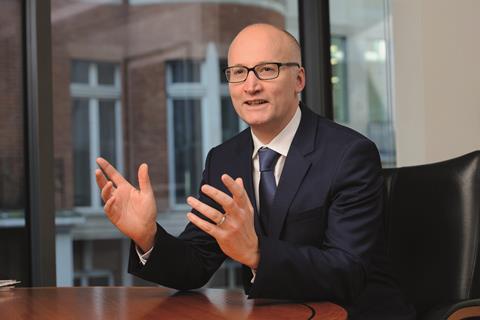
On its 175th anniversary in 2023, Lazard’s CEO and chairman Peter Orszag set out a vision for the future of the company in which asset management played a central role. Orszag previously served as vice-chairman at Citi and was formerly director of the US Office of Management and Budget in the Obama administration and director of the US Congressional Budget Office.
In September last year, Orszag highlighted the positive trend with regards to inflows and said that the company would explore new offerings in the ETF space and build exposure to private markets. At the same time, he reiterated Lazard’s commitment to ongoing investment into fundamental research.
Lazard Asset Management key facts
$254bn (€217bn)
Total AUM of Lazard Asset Management (as of December 2025), the asset management arm of Lazard, the 178-year-old group now listed on NYSE
$100bn
European business AUM in 2025, up from about $75bn in 2022
75
Number of portfolio managers/ analysts in Lazard’s London office
1,200
Total number of employees spread over 20-plus countries
400
Number of investment professionals across the business
Inflection point
LAM occupies an increasingly awkward space in the market. Managing around $254bn (€217bn) of client assets, it is neither large nor small in terms of assets under management (AUM). It has an unrelenting focus on active management driven by fundamental research – a style of asset management that, especially with listed equities, has had a hard time justifying its existence over the past decade.
“Our business has been under constant pressure from the rise of passive investing and private markets,” Taylor admits.
“This is a really interesting inflection point for active management, after years during which it faced an almost existential threat. But the shape of the market has changed completely,” he adds.
In 2025, outflows started to give way to inflows. The firm’s European business crossed $100bn of AUM, from about $75bn three years ago. Lazard’s EM equity and Japanese equity strategies, which have a multi-decade track record, gained traction. Demand for Lazard’s listed infrastructure strategy soared, as investors took a keen interest in its inflation-protection properties. The $19.7bn strategy is closed to separate accounts, because of capacity constraints, but it is still open in fund form.
“We build niche products, but also strong franchises, beyond the traditional global and US-equity focused strategies,” Taylor says.
Building on this strong foundation, the company will continue to invest in developing its core fundamental research abilities, according to the CEO.
Taylor has been with the firm for more than 20 years, having joined as telecoms analyst from UBS. Prior to being appointed co-CEO eight years ago, he was the firm’s head of research.
Hailing from rural Yorkshire, Taylor was set to take over his family’s haulage business after studying engineering, economics and management at Oxford, which is why he also obtained a heavy goods vehicle licence.
The unforeseen closure of the family business drove Taylor into investment banking at SBC Warburg, which would later become UBS. There, he worked on the €10bn IPO of Telia, the Swedish telecommunication company – the largest IPO Europe had seen at the time.
He then became a telecoms analyst and joined Lazard shortly after the bursting of the TMT bubble. His appointment as co-CEO in London shows how serious the company is about fundamental research.
“It is possible to generate alpha through research, and we have proved that over decades”
“It is possible to generate alpha through research, and we have proved that over decades,” says Taylor. “Anyone joining Lazard understands that we have a very fundamental and research-driven approach. We hold some 4,800 meetings a year and leverage our globally shared research database.”
The company’s core investment philosophy is based on return on capital and valuation, according to the CEO. “We have conducted studies spanning over 25 years that show how stickiness of return on capital over time is linked to earnings growth, and ultimately increased shareholder returns. That is a key part of our philosophy,” he says.
Based on these principles, Lazard has built a roster of successful strategies, most of which consist in concentrated portfolios of 25-50 stocks. In 2007, the firm launched a quant strategy run by an experienced team that joined Lazard from State Street.
“We understood that investors may want a lower-priced product, with no style or orientation. The quant team sits well within Lazard because they apply similar principles, looking at key metrics but also trying to understand each industry they invest in,” says Taylor. His goal is to build on the company’s existing partnerships, but also to expand its footprint in Europe and the UK, by winning the argument for modern-day active management.
“Active management is at a low,” Taylor says. “Most of our strategies have significant capacity and we can easily more than double the assets without any constraints. At the same time, we are constantly looking for new opportunities to develop niche strategies. One example of this philosophy is one of our oldest strategies focusing on discounted assets.”
The strategy focuses on UK investment trusts, which often trade at a material discount to NAV. Recently, the company launched a listed private markets strategy, “a liquid version of a private equity strategy” that Taylor says is generating interest among investors concerned with liquidity.
“I tell my colleagues that AI won’t take their jobs, but someone who uses AI well might do”
As someone who has focused on research for the best part of his career, Taylor sees his job as keeping people focused on generating good investment ideas to deliver performance. “It’s not about how many research notes our analysts write or how much assets we raise. We need to be entirely investment-focused and measured on the long-term performance we deliver for clients,” he says.
That is why Lazard maintains an “investment-heavy, marketing-light” mix in the London office, where around 75 employees are analysts and portfolio managers and 12 have client-facing roles. Overall, 40% of the company’s staff is dedicated primarily to investment.
Drawing from his experience as a research analyst during the dotcom bubble, Taylor has strong views about the rise of AI. But he is less interested in how the current AI-driven bull market could unravel than in how AI can change the way businesses operate – including his own.
“There is no doubt that AI can deliver a significant productivity boost,” he says.
“Today, the speed of information flow is so much greater. If there is going to be a change in fundamental investing, it depends on how we adopt AI into the investment process, and where human judgment steps in,” Taylor notes.
Enabling Lazard’s employees to focus on performance will therefore require a bold but considered approach to adopting AI. A key part of the process will be assessing the quality of the information delivered by AI tools.
“I tell my colleagues that AI won’t take their jobs, but someone who uses AI well might do,” Taylor says.
Jeremy Taylor is co-CEO, Europe and co-head of European distribution at Lazard Asset Management (LAM). He joined Lazard in 2003 as research analyst, focusing on telecoms. He later served as co-director of research and was appointed CEO in 2018. Peviously, Taylor was an analyst at UBS Warburg.




.jpg)